
eSIM plans for South Korea
Compare 1882 live offers from 17 providers. Prices update every 12 hours.
227
offers shown
$0.42
cheapest
$0.38
best $/GB


Couldn't load the full plan list. Showing top plans only — please try again.

Find the best-fit eSIM for South Korea. Simple filters, clear comparisons, faster decisions.
Compare 1882 live offers from 17 providers. Prices update every 12 hours.









A South Korea eSIM is a digital mobile data plan installed by QR code before you travel. It connects to Korean networks the moment you land at Incheon International Airport (ICN) without a SIM swap. Unlike many destinations, South Korea’s mobile infrastructure is among the fastest in the world. Standard international roaming rates still apply without a South Korea eSIM or local plan, so most visitors from the US, UK, EU, Canada, and Australia pay per-day roaming fees that exceed the cost of a week-long eSIM plan within a day or two. Citizens of 67 countries including the US, UK, EU members, Canada, and Australia can also enter South Korea visa-free for up to 90 days. The K-ETA requirement is waived until December 31, 2026 for eligible nationalities. A mandatory e-Arrival Card must be submitted at www.e-arrivalcard.go.kr before landing.
This page ranks the best eSIM for travel to South Korea across nine providers. It compares South Korea eSIM plans by price per GB, network partner, and the specific realities of navigating Seoul‘s subway without Google Maps, taking the KTX bullet train to Busan, and staying connected on Jeju Island — so you can choose the right South Korea eSIM card before you leave home.
eSIM (embedded SIM): A digital SIM profile installed via QR code or app, no physical card required. In South Korea, it connects to SK Telecom, KT, or LG U+ depending on the plan chosen
South Korea is one of the few countries where the mobile network quality genuinely exceeds what most visitors have at home. Seoul’s subway has full underground coverage on all three networks. The KTX bullet train maintains 5G at 300 km/h. Every convenience store, jjimjilbang, and street-food alley has signal. What makes the eSIM decision even more straightforward here is navigation. Google Maps does not work for public transit directions in South Korea due to government restrictions on map data export. Naver Map is the replacement, but it requires active data to function. A working South Korea eSIM means Naver Map is ready at the airport gate. Papago, the essential Korean translation app, also runs on mobile data for camera-based menu translation.
Installing before the flight means landing at Incheon with data active from the moment immigration is cleared. Your home SIM stays live in the background for calls and messages. Kakao T loads for the taxi from Incheon to your hotel in Hongdae or Myeongdong, and Kakao T account setup requires SMS verification, so it must be configured before arrival. The SIM counters at Incheon can run 30 to 60 minutes during peak arrivals. A South Korea eSIM eliminates that queue entirely and costs roughly the same as a local prepaid SIM.
Our methodology applies six criteria: price per GB, network partner quality, activation ease, hotspot support, data validity, and customer support. South Korea adds one consideration unique to this destination: the network partner matters less here than almost anywhere else. SK Telecom, KT, and LG U+ all deliver world-class coverage in cities and on all major transit routes.
The main difference is in the rare case of rural hiking. SK Telecom has the marginal edge at remote trailheads like Seoraksan and Jirisan national parks. For any trip that stays on the main tourist circuit, all three operators perform equivalently.
Price per GB
Median price per GB across eligible provider plans, weighted toward common traveler data sizes.
Network coverage
Population and geographic coverage across major cities, tourist regions, transit routes, and rural areas.
Network partner
The local mobile operator used by each plan, scored by coverage strength, reliability, and 4G or 5G availability.
Activation speed
QR-code-to-data time. Most providers under 2 minutes; some require app install.
Hotspot support
Tethering allowed on all plan tiers without extra fees or fair-use throttling.
Customer support
24/7 chat availability, response time, and refund track record on canceled trips.
The provider grid below shows all plans from Airalo, Saily, Ubigi, Nomad, Yesim, Alosim, Maya Mobile, and Redteago that include South Korea coverage. Most connect through KT or SK Telecom. For South Korea, the network partner matters less than the price and validity — all three operators are excellent.




The best overall South Korea eSIM is ranked on price per GB, the network partner, activation ease, hotspot support, validity, and support quality. South Korea’s network quality means no plan is penalized for connecting to any of the three operators. What differentiates plans is price, validity length, and whether hotspot is included.
Best for: first-time visitors to Seoul, K-pop fans planning to attend concerts or visit fan cafes, couples on a Seoul-Busan-Jeju circuit, families with multiple devices, and travelers who want one plan that works from the Gyeongbokgung Palace to the Jeju crater trail.
A representative trip covering Seoul (4 to 5 days), the KTX down to Busan with a visit to Haeundae Beach and Gamcheon Culture Village (2 to 3 days), and a flight to Jeju Island with time at Hallasan National Park and the Seongsan Ilchulbong sunrise peak (2 to 3 days) covers three distinct experiences in around 8 to 10 days.
In Seoul, data is in near-constant use. Naver Map routes each subway leg, including which exit number to take. Papago camera-translates Korean-only menus in Gwangjang Market and Tongin Market. KakaoTalk handles hotel confirmations and tour operator messages. Kakao T books taxis for the late-night ride home from Itaewon or Gangnam.
On the KTX, data is steady at 5G throughout the journey. On Jeju Island, coverage covers the full circuit from Jeju City to Seogwipo to the Hallasan trailheads. Most tourists in this pattern use 700 MB to 1.5 GB per day whereas heavy social uploaders from K-pop concert venues or Bukchon Hanok Village photo spots use 2 to 3 GB per day. A 10 to 15 GB plan with 10-day validity covers most 8-night trips.
The strongest overall South Korea eSIM is the plan in the table above that pairs the right validity window with a data allowance sized for the trip. Unlike most countries, network partner selection is a minor variable here. Hotspot support matters if a laptop is part of the workflow at a Seoul coworking café.
The value section below covers the most efficient plans by price per GB.
Best value in South Korea means the lowest defensible cost per GB from a named provider. Because all three Korean operators are excellent, a cheap plan on any of them is a genuine value option — not a coverage compromise. This makes South Korea one of the few destinations where the cheapest plan is also reliably the safest plan.
Best for: budget travelers on a Seoul-only trip, backpackers doing the Seoul-Busan K-rail pass route, European visitors on a first Korea trip, solo travelers staying in Hongdae or Itaewon guesthouses, and anyone whose evenings are spent at accommodation WiFi.
A solo traveler spending five days in Seoul uses Naver Map constantly — it is unavoidable on a city with 23 subway lines. Papago translates menus at Namdaemun Market and convenience stores. Kakao T books a taxi from Hongdae late at night when the subway has closed. KakaoTalk handles guesthouse check-in messages and this pattern typically runs 500 MB to 1 GB per day. A 5 GB plan covers five days comfortably. Adding a KTX day trip to Gyeongju for the ancient tumuli and Bulguksa Temple does not significantly increase data use — the KTX has onboard 5G and the day is mostly walking.
A good-value South Korea eSIM should still list a named network partner and have clear hotspot terms. Ultra-small plans under 1 GB become a poor fit for any itinerary that includes a day trip. Naver Map on a multi-stop Seoul subway day uses 100 to 200 MB in navigation alone. Add Papago camera translation and photos, and 1 GB disappears fast.
The short-trip section below covers plans sized for fixed short windows.
A short South Korea trip of one to seven days does not require overbuying. But even a 48-hour Seoul layover creates genuine data needs immediately on arrival. Naver Map routes the AREX airport train from Incheon to Seoul Station. Papago translates the convenience store receipt. Kakao T books the taxi to the hotel after midnight. All of this happens before the first full day of tourism begins.
Best for: layover travelers transiting through Incheon, weekend K-pop fans flying in for a specific concert, business travelers attending conferences in Seoul’s COEX or Dongdaemun Design Plaza, solo visitors on a 5-day Seoul city break, and couples doing a short Busan coastal trip.
A 5-day Seoul itinerary typically covers Gyeongbokgung Palace, Bukchon Hanok Village, the Myeongdong shopping strip, a day in Insadong, a night in Hongdae, and at least one music show or K-pop fan cafe. Naver Map is the backbone of every transit leg. Subway Korea shows real-time arrivals on Seoul Metro‘s nine-plus lines and CatchTable reserves seats at popular restaurants that fill weeks in advance. A light user on maps, messaging, and occasional photos uses 400 to 700 MB per day. A visitor uploading Instagram stories from N Seoul Tower and live-streaming a K-pop concert uses 1.5 to 2 GB per day. A 5 GB plan covers most 5-day Seoul visits whereas a 7 GB plan is the safer choice for anyone adding a day trip to Nami Island or Suwon Hwaseong Fortress where maps run all day.
Short-validity plans match data to a fixed travel window. If South Korea is one stop on a broader Asia itinerary, check whether the provider offers a regional Asia plan. Many providers offer Asia-wide coverage at a similar price to a Korea-only plan. That option provides better value if the trip continues to Japan, Taiwan, or Southeast Asia.
The long-stay section below covers multi-week itineraries.
Long stays in South Korea cover several very different traveler types. Language students at Seoul universities typically stay 3 to 6 months. Digital nomads working from cafes in Seongsu or Mapo use data continuously. Slow travelers doing a full regional circuit from Seoul to Andong to Gyeongju to Busan to Jeju Island need consistent coverage for 3 to 4 weeks. Each of these profiles puts different demands on data allowance.
Best for: digital nomads based in Seoul for a month, language students at Korean universities, slow travelers doing the full country circuit, visiting-family travelers spending extended time outside Seoul, and K-culture enthusiasts following a multi-week itinerary of concerts, fan events, and regional travel.
A 21-day trip from Seoul to Jeonju (Hanok Village, bibimbap) to Gyeongju (Bulguksa Temple, Cheomseongdae) to Busan (Haeundae, Gwangalli, Gamcheon) to Jeju Island covers a mix of city subway, intercity KTX, domestic flights, and rural road travel. Data use is consistent throughout: Naver Map on every leg, Papago at every local restaurant, KakaoTalk for guesthouse communication, and Coupang Eats or Baemin for food delivery on rest days.
Coworking stays in Seoul‘s Gangnam, Seongsu, or Hongdae districts typically use 20 to 35 GB per month for Zoom calls and cloud sync. Hotspot from an Airbnb adds significantly: a workday on hotspot uses 3 to 5 GB. A 20 to 30 GB plan with 30-day validity covers most long-stay travelers who are not remote workers.
Topping up mid-trip is easy in South Korea — provider websites load quickly on all three networks and airport WiFi at Incheon is very reliable for plan extensions. Hotspot support is important for long stays. Confirm the plan’s hotspot policy before purchasing if a laptop is part of the daily workflow.
Remote workers and heavy hotspot users should consider unlimited plans, covered next.
Unlimited plans are justified in South Korea for a specific reason: the network speeds here are fast enough that usage runs up quickly. Downloading a 4K travel video from a Bukchon Hanok Village drone shot uses 3 GB in minutes on 5G. A Zoom call from a Seongsu coworking cafe uses 1 GB per hour. A K-pop fan live-streaming a concert from the floor of KSPO Dome or Jamsil Olympic Stadium can exhaust 5 GB in a single evening.
Best for: content creators uploading 4K from Seoul rooftops or Jeju coastlines, remote workers on daily video calls from Seoul coworking cafes, K-pop fans attending multiple concerts and fan meets, families sharing a hotspot across multiple devices, and digital nomads on 30-day stays.
The practical unlimited use cases in South Korea are faster and more intense than in most destinations. South Korea had the fastest 5G national median (427.5 Mbps) in Asia-Pacific as of Q2 2024 and That speed means data is consumed at rates that would take hours elsewhere.
Content creators at Gangnam can upload a 1 GB edited reel in under three seconds on 5G while remote workers hotspotting from Insadong or a Jeju cafe use 3 to 5 GB per workday. Families sharing a hotspot across phones and tablets on a Jeju car rental circuit need a plan that does not meter consumption.
Unlimited plans here carry fair-use policies: after a daily high-speed threshold (usually 3 to 5 GB), speeds are throttled to 128 Kbps or 1 Mbps until the next day’s reset. At throttled speeds, Naver Map and messaging still work but video streaming does not. Check daily speed limits carefully before purchasing an unlimited plan.
Unlimited is not the right choice for a solo traveler doing 5 days in Seoul on maps and messaging. A 7 GB plan covers that trip with data to spare. Unlimited earns its premium for content creation, heavy hotspot use, and multi-device families. South Korea’s coverage story is detailed in the next section.
South Korea eSIM coverage runs on SK Telecom, KT, and LG U+. The choice between them matters less here than in almost any other country. South Korea has the densest mobile infrastructure in Asia and achieved nationwide 5G coverage in April 2024. It was the world’s first country to launch commercial 5G, in April 2019. In December 2025, SK Telecom won Opensignal’s Best Network award for South Korea with nine sole wins, while KT led on raw 5G download speeds and LG U+ led on 5G availability at 90.3 percent.
In Korean cities, all three operators are fast and competitive. Seoul‘s 168.1 Mbps average download speed in July-September 2024 (Opensignal) made it the fastest city in Asia-Pacific. Coverage holds through every neighborhood; From Myeongdong shopping streets to Hongdae nightlife, from Gangnam‘s COEX mall basement to Bukchon Hanok Village‘s narrow alleys, signal does not drop.
Busan‘s Haeundae Beach and Gwangalli Bridge carry strong 5G. Incheon‘s Songdo International City was built as a smart city with 5G integrated from the ground up. Daegu, Gwangju, and Daejeon all deliver full urban coverage.
Transit coverage is a genuine differentiator from the rest of the world. Seoul Metro‘s entire underground network has full mobile coverage on all three operators. You will not lose signal in a tunnel. The KTX high-speed rail maintains 4G and 5G along all major routes: Seoul to Busan, Seoul to Gwangju, and Seoul to Gyeongju. The AREX airport express from Incheon to Seoul Station has consistent data throughout the 43-minute journey whilte The KTX speed of 300 km/h is accompanied by 5G speeds above 100 Mbps throughout most routes.
Tourist regions have excellent coverage. Jeju Island has comprehensive coverage across the full island and Hallasan National Park trails are covered at the main visitor areas and on most trail sections up to the summit. Seongsan Ilchulbong (Sunrise Peak), Manjanggul Cave, and the Jeju Olle coastal walking trail all maintain signal. Gyeongju‘s UNESCO heritage sites including Bulguksa Temple, Seokguram Grotto, and the Tumuli Park burial mounds all have full coverage. Andong‘s Hahoe Folk Village, Suwon Hwaseong Fortress, and Nami Island all deliver reliable data for navigation and posting.
Genuine coverage gaps are rare in South Korea but not nonexistent. The deep interior trails of Seoraksan National Park (particularly the Daecheonbong summit route) can drop to 3G or weaker. Remote sections of Jirisan National Park‘s ridge trails may lose 5G at altitude and very small offshore islands beyond the main tourist routes have limited coverage. For any serious hiking itinerary, download offline Naver Map sections before leaving the last urban center.
| Network | Coverage Level | 4G LTE Coverage | 5G Population | Urban Reliability | Rural Reliability |
|---|---|---|---|---|---|
| SK Telecom | BEST OVERALL | ~99.9% | ~99% (operator disclosure; led nationwide rural 5G rollout) | Highest — 9.4/10 Opensignal Coverage Experience; 9 sole Opensignal award wins | Best — marginal edge at remote trailheads and farming/fishing villages |
| KT | FASTEST 5G DOWNLOAD | ~99% | ~99% (nationwide 5G SA launched 2021, first in South Korea) | Strong — fastest 5G DL nationally per Opensignal Dec 2025; excellent in cities | Very good — slight gap vs SKT in very remote areas |
| LG U+ | HIGHEST 5G AVAILABILITY | ~99% | ~90.3% 5G Availability (highest per Opensignal Dec 2025) | Strong — wins 5G Availability award; indoor and subway coverage excellent | Good — minor gaps outside populated areas vs SKT |
SK Telecom is the right network partner for any itinerary that goes beyond the main cities. It offers the strongest overall coverage, the highest Opensignal scores, and the best rural reach. It is the network of choice for Jeju hiking, remote coastal driving, and the rare dead zones on mountain trails. KT delivers the fastest raw 5G download speeds in urban environments and is the network behind many major eSIM providers’ Korea plans. LG U+ wins on 5G availability, meaning users spend more time connected to 5G rather than 4G.
All three operators jointly built a 5G network for rural farming and fishing villages, completed in April 2024. Dead zones in South Korea are genuinely rare. The eSIM provider chooses the network partner, so check the plan details before purchasing.
Yes, exceptionally well. South Korea’s three main tourist destinations are among the best-connected places in the world. The city cards below show measured speeds, latency, and availability. The performance differences between SK Telecom, KT, and LG U+ in these cities are negligible for travel use.
Seoul is the single most complex transit city in Asia for a first-time visitor. It has 23 subway lines, dozens of bus routes, and a street-numbering system that requires an app to navigate. Every single one of those subway lines has full underground mobile coverage. Naver Map routes every leg with exit numbers, escalator locations, and walking time from the station. Without a working South Korea eSIM, navigating Seoul by public transit becomes significantly harder — Naver Map requires data. From Gyeongbokgung Palace in the north to Gangnam in the south, from Hongdae in the west to Dongdaemun Design Plaza in the east, signal never drops.
Busan, South Korea’s second city, has all three networks performing strongly. Haeundae Beach and the Gwangalli Bridge waterfront have excellent 5G. The Gamcheon Culture Village hillside neighborhoods need Naver Map to navigate — and data holds throughout. The Haedong Yonggungsa Temple coastal trail and Jagalchi Fish Market both carry full coverage. Busan Metro‘s underground lines have full coverage, same as Seoul.
Jeju Island has comprehensive coverage across the entire island from all three operators. This is notable given that Jeju is a separate island requiring a domestic flight or ferry. The Hallasan crater trail, Seongsan Ilchulbong sunrise peak, Manjanggul Lava Tube, the Jeju Olle walking trail, and the Aewol coastal cafes all have usable data. Minor dips occur on the upper Hallasan summit approach above the tree line. Download Naver Map’s Jeju offline section before hiking nonetheless.
Data
Best network
SK Telecom / KT
Median speed
Latency
~15 to 25 ms
Data
SK Telecom / KT
~18 to 28 ms
Data
SK Telecom / KT
~20 to 30 ms
Data
SK Telecom / KT
~18 to 25 ms
Beyond the four city cards, Gyeongju received a boost from the APEC 2025 summit, which drove significant infrastructure investment and a 21 percent rise in foreign visitors. Coverage across its UNESCO sites is excellent. Jeonju’s Hanok Village has full coverage; notably, Jeonju once recorded the world’s fastest 5G city download speed, at 415.6 Mbps, in Opensignal data. Andong Hahoe Folk Village, Nami Island, a ferry island near Gapyeong, and Suwon Hwaseong Fortress all have reliable data for navigation and posting. 5G is strongest in Seoul’s Gangnam, Yeouido, and Mapo districts, as well as along the KTX corridor. Everywhere else in populated areas, 4G is the dependable fallback. Realistic caveats: deep mountain trails in the Seoraksan and Jirisan interiors may drop to 3G above a certain altitude, and very remote offshore islands have limited coverage. Peak congestion at major K-pop events at KSPO Dome or Seoul Olympic Stadium can temporarily slow all networks.
The next section gives the honest trade-offs before setup
South Korea is one of the simplest countries in the world for eSIM use: no regulatory blocks, no registration hurdles, and world-class networks. Three things are worth knowing before arrival.
Google Maps does not work for transit navigation. This is the most important practical point for any first-time Korea visitor. Due to South Korean government restrictions on map data export, Google Maps cannot provide public transit directions or turn-by-turn navigation in South Korea. Naver Map is the replacement, and it requires active data to function. Download Naver Map before the flight and set the language to English in the app settings. Papago is the companion app for Korean menu and sign translation. Both apps run on mobile data. A working South Korea eSIM is therefore not just a convenience; it is a navigation requirement from the moment you exit Incheon arrivals.
Set up Kakao T before departure. Kakao T is South Korea’s main ride-hailing app and works like Uber. It requires a phone number for SMS verification during account setup. If you try to create an account after landing, you may need your home SIM for the verification code. If your home SIM is in roaming-off mode, that step fails. Set up the account at home, link a credit card, and it will work seamlessly on arrival. The same applies to KakaoTalk, which hotels and tour operators use for booking confirmations.
Device compatibility and frequency bands. Most modern flagship phones support South Korea’s frequency bands: SK Telecom uses Band 1/3/5/7/40/n78; KT uses Band 1/3/5/8/n78; and LG U+ uses Band 3/5/7/28/n78. iPhones from XS onward and flagship Androids from Samsung, Google Pixel, and OnePlus all support eSIM and Korean 5G bands. Some budget or regionally locked Android devices may not. Check compatibility for the exact model before purchasing.
No local Korean phone number. Finally, remember that a travel eSIM does not provide a local Korean phone number. It provides data only. This matters for apps that require Korean phone verification, such as Naver Pay, KakaoPay, or Korean streaming apps. It does not affect Naver Map, Papago, Kakao T once set up at home, KakaoTalk, or any international messaging app — the apps international travelers actually need.
Activation in South Korea is straightforward with no regulatory restrictions on eSIM use. Incheon International Airport has reliable WiFi in both terminals if last-minute QR scanning is needed. Pre-departure installation is still the recommended approach. The 30 to 60 minute queue at Incheon‘s SIM counters during peak European or US morning arrivals is the main argument for doing it before the flight.

Pick a plan, pay, get a QR code by email within ~60 seconds.

iPhone: Settings → Cellular. Android: Network → SIMs → Add eSIM.
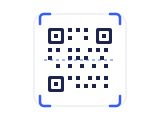
Point your phone at the QR on a second screen, or paste the activation code.

Name it “eSIM” so it’s obvious in your line picker.
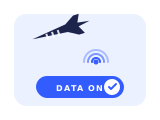
Toggle the eSIM line on as you land. Data works on the jet bridge.
eSIM compatibility is the same in South Korea as globally. South Korea’s 5G networks use band n78 (3.5 GHz), which all current flagship devices support. Note that some dual-physical-SIM Android devices manufactured for the China or India market may not support eSIM at all. Verify eSIM capability for the exact model before purchasing a plan.
XS, XR, 11, 12, 13, 14, 15, 16 & SE (2nd gen+)
Yes. South Korea is outside the EU Roam Like at Home zone. No home SIM from Europe, the UK, Australia, or North America provides automatic roaming protection here.
The standard dual-SIM setup for South Korea: set the South Korea eSIM as the default data SIM and keep the home SIM active in the background for incoming calls and texts. This means calls from family reach you normally. Two-factor authentication codes for banking apps arrive on the home number. KakaoTalk messages and hotel booking confirmations all land as expected. Naver Map, Papago, Kakao T, and all data apps run on the Korean plan.
One practical note: verify before any day of heavy subway travel that the South Korea eSIM is set as the default data line. Accidentally using the home SIM for a long Naver Map session in Seoul‘s subway can generate roaming charges quickly. Disable data roaming on the home SIM explicitly after installing the South Korea eSIM to prevent this.
The South Korea data calculation has a specific driver: Naver Map. Because Google Maps does not work for transit navigation here, Naver Map runs continuously. A full day in Seoul using the subway, walking between historic sites, eating at local restaurants with Papago menu translation, and posting one photo set to Instagram uses 800 MB to 1.2 GB. A KTX travel day to Busan or Gyeongju uses less data — the journey has onboard 5G and the day is mostly sightseeing. A content-heavy day at a K-pop concert or on Jeju Island uploading photos to Instagram can run 2 to 3 GB. Eight days of mixed Seoul and regional travel typically needs 8 to 12 GB.
Activity | Avg rate | Intensity | 7–14 day total |
|---|---|---|---|
Google Maps + navigation | 50 MB/hr | ~3 GB 5 hr/day × 7 days | |
Instagram, TikTok, social | 700 MB/hr | ~10 GB 1 hr/day × 14 days | |
YouTube / Netflix (480p) | 550 MB/hr | ~8 GB 1 hr/day × 14 days | |
Work calls + email | 200 MB/hr | ~4 GB 2 hr/day × 10 days | |
iMessage, WhatsApp, light | 10 MB/hr | <1 GB Background use |
Buy before departure. Incheon International Airport handles over 76 million passengers annually and processes the majority of South Korea’s international arrivals in a single terminal complex. The SIM card counters in the arrivals hall have documented 30 to 60 minute queues during peak morning arrival windows from Europe and North America. More importantly, Naver Map requires data before the queue is even relevant.
Without an active South Korea eSIM, navigating from the arrivals gate to the AREX airport train platform in a terminal that is entirely labeled in Korean requires data-based translation. At Gimhae Airport in Busan, WiFi in arrivals is less reliable. Pre-departure installation is a five-minute task at home that eliminates all of these friction points.