eSIM plans for
Compare 0 live offers from 0 providers. Prices update every 12 hours.
Find the best-fit eSIM for Slovenia. Simple filters, clear comparisons, faster decisions.
Compare 0 live offers from 0 providers. Prices update every 12 hours.
Finding the best eSIM for Slovenia starts with understanding how the country connects: Slovenia runs on three network operators, an expanding 5G footprint, and a single major international gateway in Ljubljana. This page ranks the top Slovenia eSIM plans for 2026, covers eSIM for travel to Slovenia from arrival at Ljubljana Joลพe Puฤnik Airport (or a cross-border transfer from Trieste, Venice, Zagreb, Graz, or Klagenfurt) through to day trips at Lake Bled and the Adriatic coast, and explains how a Slovenia eSIM compares with a physical Slovenia eSIM card for Schengen-area travel under the standard 90/180-day visa-free entry rules for US and UK visitors.
Each plan above is scored against the same six-point methodology described below, so the comparison stays consistent whether the trip is a two-night stop in Ljubljana or a ten-day loop through the Julian Alps and the coast.
eSIM (embedded SIM), a digital SIM profile installed via QR code or app (no physical card), used to connect a compatible phone to a mobile network. In Slovenia, it connects to Telekom Slovenije, A1 Slovenija, or Telemach depending on the plan you choose.
Buying a Slovenia eSIM before departure removes one variable from an arrival routine that can already involve a queue. Travelers landing at Ljubljana Joลพe Puฤnik Airport from outside the EU are now moving through the EU’s Entry/Exit System (EES) biometric registration, rolling out in phases from October 2025 through April 2026, which can add time at passport control. A pre-installed eSIM for travel to Slovenia means the phone connects the moment the plane lands, with no need to find a kiosk or swap a physical card, and the same profile works for travelers who fly into Trieste, Venice, Zagreb, Graz, or Klagenfurt and transfer overland into Slovenia by shared shuttle services like GoOpti.
The second reason is cost. Roaming through a home carrier in Slovenia typically runs 60-90% more than a dedicated Slovenia eSIM plan covering the same data allowance. That gap matters for practical, everyday use: checking a route on Urbana (Ljubljana‘s transit card and app) before boarding a bus, or booking an intercity connection on Nomago to reach Bled or the coast.
Our methodology weighs price per GB, network coverage, and network partner quality equally, then adjusts for how each provider performs across Slovenia‘s specific travel patterns, from short Ljubljana city breaks to multi-region alpine and coastal itineraries. This structured approach is what surfaces the best eSIM for Slovenia for each travel pattern, rather than a single blanket recommendation.
Price per GB
Median price per GB across eligible provider plans, weighted toward common traveler data sizes.
Network coverage
Population and geographic coverage across major cities, tourist regions, transit routes, and rural areas.
Network partner
The local mobile operator used by each plan, scored by coverage strength, reliability, and 4G or 5G availability.
Activation speed
QR-code-to-data time. Most providers under 2 minutes; some require app install.
Hotspot support
Tethering allowed on all plan tiers without extra fees or fair-use throttling.
Customer support
24/7 chat availability, response time, and refund track record on canceled trips.
Multiple providers on our whitelist, including Airalo, Saily, Ubigi, Nomad, Yesim, Alosim, Maya Mobile, and Redteago, offer plans that route onto Slovenia‘s three national networks. Coverage strength depends on which local network partner a given plan uses, which is why the table below breaks down each operator separately before the ranked comparisons.
The best overall pick balances six factors: network coverage, validity window, data allowance, hotspot support, activation speed, and cost per GB, none of which favor one provider outright since the right fit depends on the traveler. A short Ljubljana city-break visitor arriving through EES-era passport control needs fast activation and light data (300-500MB/day for maps and messaging, 700MB-1.5GB/day for regular browsing and Urbana/Nomago use), while a traveler running a multi-country loop through Bled, the Julian Alps, and across the border into Croatia or Italy needs broader regional coverage and a longer validity window.


The strongest overall Slovenia eSIM options tend to pair solid Telekom Slovenije or A1 Slovenija network access with a validity window that covers the full trip length without forcing a mid-trip top-up. Hotspot support matters for travelers sharing one plan across devices in a rental car heading to the coast, and activation speed matters most on the first day in Ljubljana. The next question narrows this down further: which plan actually costs the least per gigabyte.
Framed as best value rather than simply cheapest, the right low-cost pick for Slovenia suits the country’s typical trip pattern: a national average of 3-4 nights, and just 2.1 nights in Ljubljana specifically, meaning most visitors need a compact, low-data plan rather than a large monthly allowance. Budget travelers walking Ljubljana‘s Old Town, checking Urbana for tram and bus timing, and booking a Nomago bus to Bled typically use 300-700MB per day if they avoid streaming video.


A best-value Slovenia eSIM plan still needs to run on a reputable network, carry a validity window that matches the trip length, and activate without friction, since a low price on a plan that lapses mid-trip or drops signal is no saving at all. This value tier is a poor fit for travelers heading into the Julian Alps for hiking around Bohinj or Kranjska Gora, or into the Karst region‘s cave systems near Postojna, where terrain limits coverage regardless of price point. Shorter trips call for a slightly different lens, covered next.
A short-trip Slovenia eSIM fits the country’s most common visitor pattern: Ljubljana plus Lake Bled over a long weekend, sometimes extended with a day trip to Postojna Cave or Predjama Castle in the Karst region. Travelers on this itinerary lean on Urbana for city transit, Nomago for the roughly 45-minute intercity run to Bled, and ride-hailing apps like Bolt (Ljubljana and Maribor) or Uber (Ljubljana only) for point-to-point trips. Data needs for this window run 1-3GB for light use (maps, messaging, transit apps) up to 3-5GB for travelers who also stream music or navigate with live traffic.


Daily or short-validity plans fit this fixed window well, since there is no need to pay for a data allowance that outlasts the trip. 5G is strongest in Ljubljana and Maribor, so short-trip travelers sticking to the capital and major cities can expect fast, reliable data throughout. Longer, multi-region itineraries change the calculation, which the next section covers.
Long-stay travel in Slovenia usually means a full-country tour: Ljubljana to the Julian Alps (Bohinj, Kranjska Gora, Triglav National Park), on to the Soฤa Valley, then the Karst region (Postojna, ล kocjan Caves) and the Adriatic coast (Piran, Portoroลพ, Koper), sometimes extended to Maribor and the Prekmurje wine country. This trip length is also common as a combined Slovenia-Croatia, Slovenia-Italy, or Slovenia-Austria multi-country loop, given how short the drives to each border are. Travelers on this pattern lean on Nomago for intercity routes and the Slovenske ลพeleznice / Sลฝ app for rail connections between larger towns.


At this length, the trade-off is a single large data allowance against a smaller plan topped up along the way, and hotspot support becomes more important since a multi-region tour often means sharing one connection across a rental car’s navigation and several devices. Regular use over 7-10 days typically runs 20-30GB for the month-equivalent, with remote workers checking in from Ljubljana or the coast needing 50GB or more. Heavy data users, including anyone relying on video calls from remote parts of the Julian Alps, should look at unlimited options next.
Unlimited Slovenia eSIM plans suit heavy users: travelers hiking in the Julian Alps or around Triglav National Park where WiFi is unavailable, road-trippers driving the Ljubljana-to-coast route or the cross-border loop into Italy or Austria, and remote workers coworking from Ljubljana or Maribor for stretches of the trip. Video calls run roughly 500MB-1.5GB per hour, HD video streaming runs 1-3GB per hour, and hotspot-heavy workdays can consume 5GB or more per day, all use cases where Slovenia‘s fast national median speeds and expanding 5G make unlimited data a credible choice rather than overkill.


Unlimited plans commonly carry fair-use thresholds or speed reductions after a set volume, so it is worth checking those terms rather than assuming truly limitless full-speed data. For a light user sticking to Ljubljana‘s Old Town and a single day trip to Bled, unlimited data is often unnecessary and a smaller plan covers the trip at lower cost. Coverage quality ties all of this together, which is where the network picture matters most.
Telekom Slovenije leads on nationwide footprint, with the strongest reported network presence in Ljubljana, Maribor, and Celje, and the deepest rural reach of the three operators according to market commentary. A1 Slovenija delivers comparable urban performance and is targeting roughly 98% 5G population coverage by the end of 2025, making it a strong option in Kranj and along the coast near Koper. Telemach, formed after absorbing the former T-2 network, covers the country but is specifically flagged as less reliable outside major cities, a distinction that matters for anyone leaving Ljubljana for the countryside.
Along Slovenia’s core travel corridors, coverage stays dependable: the Ljubljana-to-Bled route, the roughly 90-minute run toward Zagreb, and the coastal drive from Ljubljana to Piran and Portoroลพ all pass through populated valleys where 4G and 5G signal holds steady on the main operators. Cross-border routes toward Trieste, Venice, Graz, and Klagenfurt, often used by travelers connecting through those airports via GoOpti shuttles, generally maintain signal on the Slovenian side up to the border itself.
Coverage thins out in Slovenia‘s mountainous and karst terrain. The Julian Alps, including high-altitude hiking routes around Bohinj, Kranjska Gora, and inside Triglav National Park, see degraded signal because mountainous terrain limits how far macro-cell towers reach. The cave systems of the Karst region, around Postojna and the ล kocjan Caves, present a similar underground and terrain-driven challenge regardless of operator.
For a traveler choosing between plans, the practical takeaway is that the network partner behind an eSIM plan matters more once the itinerary leaves Ljubljana, Maribor, or the coast. A plan tied to Telekom Slovenije or A1 Slovenija is the safer choice for anyone spending meaningful time in the Julian Alps or the Karst region, since 5G figures in Slovenia vary by operator and source (a range of roughly 75-98% depending on the report), and are best understood as “expanding rapidly, covering the large majority of the population” rather than one fixed number.
| Network Name | Coverage Level | 4G LTE Coverage | 5G Population | Urban Reliability | Rural Reliability |
|---|---|---|---|---|---|
| Telekom Slovenije | Nationwide (largest) | Near-universal (~99%, proxy) | >75% (operator-reported) | High (incumbent fiber/mobile backbone density) | Moderate-High (strongest rural footprint of the three per market commentary) |
| A1 Slovenija | Nationwide | Near-universal (~98%, proxy) | Target ~98% by end-2025 (operator-stated goal) | High in urban areas | Moderate |
| Telemach (incl. former T-2 network) | Nationwide, post-consolidation | High (~95%+, proxy) | Expanding (no independently verified %) | Moderate-High in cities | Lower outside major cities (flagged as less reliable outside cities per market commentary) |
For context, the national regulatory benchmark for 5G population coverage sits at roughly 80% (5G Observatory, March 2025), which lines up with the operator-reported range above. Telekom Slovenije is the strongest single network across Slovenia as a whole. City networks vary by location, with A1 Slovenija and Telemach each performing well in specific urban pockets. Coverage is variable once travel moves into alpine or karst terrain, and the network-partner reminder holds throughout.
A Slovenia eSIM works reliably in all four cities, though the practical experience differs. In Ljubljana, coverage is strongest around the compact Old Town, the central bus and rail station used for Nomago and Sลฝ connections, and the route out to Joลพe Puฤnik Airport. In Maribor, Slovenia’s second city, both Telekom Slovenije and A1 Slovenija perform well across the city center. In Bled, coverage holds around the lake and town center but can weaken slightly on the hillside paths above the lake. In Piran, the compact coastal old town keeps most travelers within strong signal range, with A1 Slovenija and Telemach both active along the coast. Data use in these cities centers on Urbana transit lookups in Ljubljana, hotel and restaurant searches in Maribor, photo uploads and navigation around Bled, and coastal drive navigation between Piran and Portoroลพ.
| City Name | Best Network | Median Speed | Latency | Availability |
|---|---|---|---|---|
| Ljubljana | Telekom Slovenije (incumbent typically strongest in capital) | 133.23 Mbps (national median, used as city proxy) | Not independently sourced (national LTE/5G norms assumed) | High (capital city, dense network) |
| Maribor | Telekom Slovenije / A1 Slovenija | 133.23 Mbps (national proxy) | Proxy as above | High (second city) |
| Bled | A1 Slovenija / Telekom Slovenije | 133.23 Mbps (national proxy) | Proxy as above | Moderate-High (tourist town, alpine terrain) |
| Piran | A1 Slovenija / Telemach | 133.23 Mbps (national proxy) | Proxy as above | Moderate-High (coastal town) |
Slovenia’s national median mobile download speed is 133.23 Mbps (Ookla Speedtest Intelligence data via DataReportal, October 2025). No city-specific breakout exists for this figure, so it should be read as Slovenia’s national average with local color rather than a measurement taken in any one city.
Beyond these four, travelers commonly pass through Celje, Kranj, Koper, Portoroลพ, Bohinj, Kranjska Gora, Postojna, the ล kocjan Caves, and the Soฤa Valley. 5G is strongest in Celje and Kranj, both sizeable urban centers, while 4G remains the dependable fallback across the smaller towns and the Soฤa Valley. Two coverage caveats stand out for Slovenia specifically: the alpine terrain around Bohinj and Kranjska Gora limits macro-cell reach on hiking trails, and Ljubljana‘s historic Old Town buildings can occasionally cause minor signal dips on narrow, dense streets even though overall city coverage remains high.
There are a few realistic limitations worth planning around rather than reasons to avoid a Slovenia eSIM altogether.
Does EES add friction at arrival? The EU’s Entry/Exit System, rolling out at Ljubljana Joลพe Puฤnik Airport in phases through April 2026, can extend queue time for first-time non-EU entrants, so a pre-activated eSIM at least removes connectivity as a variable during that wait.
Does coverage drop in the mountains? Yes, in spots. The Julian Alps and Triglav National Park‘s higher trails see reduced signal due to terrain, so hikers should download offline maps before heading out from Bohinj or Kranjska Gora.
Do single-country plans work across borders? Not automatically. A Slovenia-only eSIM plan will not carry over into Croatia, Italy, or Austria, which matters given how often those borders come up on a Slovenia itinerary; a regional or multi-country plan is worth considering for that kind of trip.
Is a short stay in Ljubljana worth a full data plan? With the capital’s average visit running just 2.1 nights, some travelers wonder if an eSIM is worth buying for such a brief stop. It generally still is, since even a short window benefits from working Urbana and Nomago access and hands-free arrival connectivity.
Activation for a Slovenia eSIM is a short, one-time setup: install the eSIM profile via QR code or app before departure, then let the network connect automatically on arrival in Slovenia, whether that arrival is at Ljubljana or one of the cross-border alternates. Unlike a physical Slovenia eSIM card bought at a kiosk or store, there is no queue and no card to swap, since the whole process happens digitally before the trip starts.
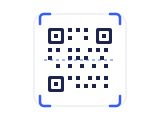
Pick a plan, pay, get a QR code by email within ~60 seconds.
iPhone: Settings โ Cellular. Android: Network โ SIMs โ Add eSIM.
Point your phone at the QR on a second screen, or paste the activation code.
Name it “eSIM” so it’s obvious in your line picker.
Toggle the eSIM line on as you land. Data works on the jet bridge.
Most recent iPhone and Android flagship models sold in the past several years support eSIM, making a Slovenia eSIM a viable option for the large majority of travelers heading to Ljubljana, Bled, or anywhere else in the country.
XS, XR, 11, 12, 13, 14, 15, 16 & SE (2nd gen+)
Yes. Dual SIM setup on a modern phone lets a Slovenia eSIM run alongside a home SIM at the same time, with one used for cellular data and the other kept active for calls and texts. In practice, this means keeping a home number reachable for calls while the Slovenia eSIM handles data for Urbana transit lookups, Nomago bus bookings, and everyday browsing across the country. A common mistake is leaving data roaming enabled on the home SIM, which can trigger unexpected roaming charges in the background; disabling data roaming on the home line while keeping the Slovenia eSIM as the default data connection avoids this.
A 3-5 day trip covering Ljubljana, a day out to Bled, and transit via Urbana and Nomago typically calls for a moderate data plan rather than a large one, especially given the country’s short average stay pattern. Use the calculator below to size a plan against specific activities, from Old Town navigation to a Postojna Cave day trip.
Activity | Avg rate | Intensity | 7โ14 day total |
|---|---|---|---|
Google Maps + navigation | 50 MB/hr | ~3 GB 5 hr/day ร 7 days | |
Instagram, TikTok, social | 700 MB/hr | ~10 GB 1 hr/day ร 14 days | |
YouTube / Netflix (480p) | 550 MB/hr | ~8 GB 1 hr/day ร 14 days | |
Work calls + email | 200 MB/hr | ~4 GB 2 hr/day ร 10 days | |
iMessage, WhatsApp, light | 10 MB/hr | <1 GB Background use |