eSIM plans for Sweden
Compare 1905 live offers from 17 providers. Prices update every 12 hours.
235
offers shown
$0.20
cheapest
$0.29
best $/GB





Couldn't load the full plan list. Showing top plans only — please try again.

Find the best-fit eSIM for Sweden. Simple filters, clear comparisons, faster decisions.
Compare 1905 live offers from 17 providers. Prices update every 12 hours.








A Sweden eSIM is a digital SIM profile that installs on a compatible phone before you fly, connecting automatically to Telia, Tele2, Telenor, or Tre on arrival at Stockholm Arlanda Airport (ARN), Göteborg Landvetter Airport (GOT), or Malmö Airport (MMX) without a physical SIM swap or airport counter stop.
This page ranks the best eSIM for Sweden across five key traveler needs, and gives you everything required to choose the right eSIM before departure — whether you are visiting for a long weekend in Gamla Stan or three weeks chasing the Northern Lights in Abisko as part of your travel to Sweden.
eSIM (embedded SIM) : eSIM, or embedded SIM, is a digital SIM profile installed by QR code or provider app instead of a physical plastic SIM card. In Sweden, an eSIM connects a compatible phone to Telia, Tele2, Telenor, or Tre depending on the plan and network partner.
A Sweden eSIM is most useful before the trip because Sweden’s first hour often depends on live mobile data. At Stockholm Arlanda, travelers may need data for Arlanda Express directions, Flygbussarna tickets, SL routing, hotel check-in messages, and baggage updates before reaching central Stockholm. At Göteborg Landvetter, mobile data helps with Flygbussarna, Västtrafik To Go, Uber, Bolt, and hotel navigation toward Korsvägen, Nordstan, or Haga. A home SIM can stay active for bank SMS and calls while the Sweden eSIM handles local data.
A Sweden eSIM also avoids the airport-counter detour in a country where public transport and payments are heavily app-led. Most travelers save meaningfully compared with international roaming and pay closer to the practical cost of a Swedish prepaid data setup, without needing to find a shop after a long-haul arrival. Stockholm visitors use SL, Google Maps, Apple Maps, WhatsApp, and booking confirmations constantly between Gamla Stan, Djurgården, Södermalm, and Norrmalm. Gothenburg and Malmö visitors often add Västtrafik To Go, Skånetrafiken, SJ, Foodora, Wolt, and QR tickets for museums, ferries, trains, and events.
Our Sweden ranking weighs price per GB, coverage, network partner, activation flow, hotspot support, and customer support against real trips through Stockholm, Gothenburg, Malmö, Swedish Lapland, Gotland, and the west coast.
Price per GB
Median price per GB across eligible provider plans, weighted toward common traveler data sizes.
Network coverage
Population and geographic coverage across major cities, tourist regions, transit routes, and rural areas.
Network partner
The local mobile operator used by each plan, scored by coverage strength, reliability, and 4G or 5G availability.
Activation speed
QR-code-to-data time. Most providers under 2 minutes; some require app install.
Hotspot support
Tethering allowed on all plan tiers without extra fees or fair-use throttling.
Customer support
24/7 chat availability, response time, and refund track record on canceled trips.
The live comparison includes approved travel eSIM providers that can serve Sweden through local network partners, including Airalo, Saily, Ubigi, Nomad, Yesim, Alosim, Maya Mobile, and Redteago.


The best overall Sweden eSIM plans balance six things: price, coverage, partner network, activation, hotspot use, and support. Sweden rewards that balanced approach because the same trip can move from Stockholm’s metro and ferries to the SJ line toward Gothenburg, then to Malmö, the Öresund area, or a northern flight to Kiruna. Light travelers often use 300 to 500 MB per day, regular tourists often use 700 MB to 1.5 GB per day, and heavier users should compare larger bundles before relying on hotel WiFi.
Best for: first-time Sweden visitors, rail-based city hoppers, family trips through Stockholm and Gothenburg, and travelers combining Arlanda arrival with Gamla Stan, Djurgården, Malmö, Uppsala, and a ferry or archipelago day.
A strong overall itinerary is a 10 to 14 day Sweden loop: land at Stockholm Arlanda, spend three nights around Norrmalm, Gamla Stan, Södermalm, and Djurgården, take an SJ train to Gothenburg for Haga, Liseberg, and the southern archipelago, then continue to Malmö for Möllevången, Västra Hamnen, Lund, and an optional Öresund day toward Copenhagen. This trip uses data for SL tickets, SJ changes, Västtrafik ferries, Skånetrafiken trains, maps, restaurant searches, QR entries, and group messaging, so the best overall plan is the one that stays dependable across transport days rather than only in the arrival city.
The live table should carry the provider ranking, plan names, data allowances, validity, and current price. The surrounding decision is simpler: choose an overall plan when the route crosses more than one coverage environment and the traveler wants one setup for the whole visit.
A plan with a stronger network partner matters most if the itinerary includes the Stockholm archipelago, the E4 or E6 road corridors, Gotland, the High Coast, or Lapland. A small plan can be a poor fit when the traveler will hotspot a laptop, stream video on long train rides, or upload winter photos from Kiruna and Abisko.
The next section narrows the choice for travelers who mainly want the best value.
For Sweden, the cheapest plan is better understood as the best value plan because a very small bundle can become inconvenient if it expires before a rail transfer or a ferry day. Budget travelers still need a reputable network partner, clear activation, enough validity, and enough data for SL, SJ, Västtrafik To Go, Skånetrafiken, maps, WhatsApp, hotel check-in messages, and restaurant searches. Light travel use is often 300 to 700 MB per day if video is avoided.
Best for: budget city breaks in Stockholm, hostel stays in Malmö or Gothenburg, students visiting Uppsala or Lund, and travelers who mostly use accommodation WiFi but need dependable mobile data between stations, airports, and neighborhoods.
A value-focused itinerary might be four nights in Stockholm with one day trip to Uppsala or Sigtuna, using mobile data for Arlanda transfer planning, SL metro gates, walking routes around Gamla Stan, tram or ferry movement toward Djurgården, and occasional searches for cafés, museums, and grocery stores. The same value logic works for Malmö and Lund if the traveler uses Skånetrafiken for short regional hops and avoids heavy video, but it becomes more fragile on longer SJ days, west coast ferries, or a Gotland trip where maps and ticketing may run for hours.
The best value plan should still be easy to install before departure and should not force the traveler to ration data every time a route changes. Sweden’s transit systems are reliable, but travel days often require live disruption checks, platform information, and QR tickets.
A value plan becomes a poor fit for navigation-heavy road trips through Bohuslän, Dalarna, Jämtland, the High Coast, or the E10 toward Abisko. A value plan also becomes restrictive when a traveler expects to use hotspot on trains or upload video from festivals, ski areas, or the archipelago.
Short trips are the next case, because they reward compact validity more than maximum data.
A short Sweden trip usually does not require overbuying because the route is often concentrated in one city and one nearby day trip. The right short-stay eSIM should activate cleanly at Stockholm Arlanda, Göteborg Landvetter, or Malmö Airport, then cover maps, transit tickets, rides, messaging, and light uploads without leaving the traveler with unused data. A light short trip can work with 1 to 3 GB, while 3 to 5 GB is safer for maps, social uploads, occasional video, and real-time transport updates.
Best for: long-weekend Stockholm visitors, conference travelers in Gothenburg, Malmö and Copenhagen side-trip travelers, cruise passengers in Stockholm, and Midsummer or Christmas-market visitors who need reliable data for a fixed window.
A practical short-trip itinerary is a three-day Stockholm break: arrive at Arlanda, take Arlanda Express or Flygbussarna into the city, use SL for the metro and tram to Djurgården, walk Gamla Stan and Södermalm, then add Vasa Museum, Fotografiska, or a ferry toward Vaxholm if weather allows. This traveler needs fast activation, dependable city coverage, and a validity window that fits the flight schedule more than a large monthly bundle, because the data workload is mostly tickets, maps, reservations, translations, and photo sharing.
Daily or short-validity plans fit Sweden when the traveler knows the arrival and departure dates. Stockholm, Gothenburg, Malmö, and Uppsala have strong 4G and 5G availability from the major networks, so short-trip performance is usually limited more by the selected network partner and the building or station environment than by the country itself.
Short plans are less attractive when the traveler adds Gotland, Abisko, ski travel, or a rental-car route. Short plans are also the wrong trade-off when a conference visitor needs laptop hotspot for several sessions.
Longer stays need a different calculation because top-ups and hotspot rules start to matter more.
Long-stay Sweden eSIM plans should be judged by monthly data comfort, hotspot support, validity, and top-up simplicity. Slow travelers, students, visiting-family travelers, and remote workers often move between Stockholm, Uppsala, Lund, Gothenburg, Malmö, and smaller towns where local WiFi quality varies by apartment, library, coworking space, or train. Regular long-stay travelers often use 20 to 30 GB per month, while remote workers and hotspot users may need 50 GB per month or more.
Best for: exchange students in Uppsala or Lund, remote workers splitting time between Stockholm and Gothenburg, visiting-family stays in suburbs such as Solna, Sundbyberg, Mölndal, or Lund, and slow travelers using SJ, regional buses, ferries, and domestic flights.
A realistic long-stay itinerary is a four-week work-and-travel stay: one week in Stockholm using SL and coworking cafés around Norrmalm and Södermalm, a rail move to Gothenburg for client meetings near Korsvägen and Lindholmen, a week in Malmö or Lund using Skånetrafiken, then a weekend flight or train connection north toward Kiruna, Luleå, or Umeå. This pattern makes hotspot support, stable validity, and network breadth more important than the lowest entry price because the Sweden eSIM becomes the backup connection for apartment WiFi, train work, food delivery, bank alerts, and travel changes.
A larger fixed plan is usually cleaner than repeated top-ups when the traveler will work, study, or move between regions. Top-ups can still be useful for flexible stays, especially when the traveler starts with a known city base and adds Lapland, Gotland, or the High Coast later. Hotspot support matters more on long stays because Swedish trains, cabins, rental apartments, and rural guesthouses can have uneven WiFi. A long-stay bundle is overkill for a compact city break or a traveler who will use office WiFi every day.
Unlimited plans are the next step only when daily data pressure is truly high.
An unlimited Sweden eSIM is most useful for heavy data users, not for the average museum-and-restaurant visitor. Video calls can use 500 MB to 1.5 GB per hour, HD video can use 1 to 3 GB per hour, and hotspot workdays can exceed 5 GB per day. Sweden has strong mobile infrastructure, but long trains, winter trips, island transfers, and cabins can make mobile data the fallback when WiFi is unavailable or slow.
Best for: remote workers on SJ routes, families sharing hotspot in rental cars, festival travelers in Stockholm or Gothenburg, Lapland winter travelers, photographers uploading from Abisko or Kiruna, and long ferry or archipelago days where WiFi cannot be assumed.
A high-data itinerary might start with work calls from Stockholm, continue by train to Gothenburg, add a ferry day in the southern archipelago, move through Malmö and Lund, then fly north for Kiruna, Jukkasjärvi, and Abisko. That route can burn data quickly through Teams or Zoom calls, cloud photo backup, map downloads, children’s streaming, weather checks, aurora forecasts, taxi apps, and hotspot sharing in guesthouses or on trains.
Unlimited plans still need careful comparison because fair-use policies, hotspot limits, and daily speed behavior can differ by provider. A plan marketed as unlimited may slow after heavy use, so the live table should be checked for the current policy instead of assuming full-speed data all day. Unlimited data is often unnecessary for a traveler who mostly uses hotel WiFi and needs mobile data for tickets, maps, and messaging. Unlimited data is a poor trade-off for a short Stockholm or Malmö trip when a smaller bundle would cover the actual workload.
Network coverage matters next, because unlimited data is only useful where the selected partner performs well.
Sweden’s strongest overall coverage signal comes from Telia, which OpenSignal reports as the winner for overall Coverage Experience in the December 2025 Sweden report. Telenor leads overall download speed in that report, while Tele2 is strongest on 5G download speed and shares the 5G coverage lead with Telenor. In practical travel terms, Stockholm, Gothenburg, Malmö, and Uppsala are strong 4G and 5G environments across the major networks. Telia remains the safer network-partner preference when the route leaves the southern urban belt.
Inter-city coverage is generally dependable on the main travel corridors, but Sweden’s size makes route choice important. The Stockholm to Gothenburg rail corridor, the E4 toward Uppsala, Gävle, Sundsvall, and Umeå, and the E6 along the west coast toward Halmstad, Helsingborg, and Malmö are easier network environments than sparsely populated inland roads. Coverage can vary inside train carriages, in deep cuttings, and around station interiors, especially when many travelers are connected. Ferry movement around the Stockholm archipelago, Gotland, and the Gothenburg southern archipelago can also shift phones between stronger and weaker cells.
Remote and seasonal regions need more care. Swedish Lapland, Abisko National Park, Sarek, Padjelanta, the High Coast, Dalarna, Jämtland, Gotland, Öland, and the outer parts of Bohuslän can move quickly from excellent town coverage to variable signal on roads, trails, boats, and cabins. The issue is rarely the center of Kiruna, Luleå, Umeå, or Visby. The harder moments are the drive out of town, the hiking area, the ferry crossing, the ski cabin, or the thick-walled historic building.
The practical implication is that network partner matters most for travelers who leave Sweden’s biggest cities. A Stockholm-only visitor can focus on price, validity, and easy activation. A road-trip traveler, Lapland visitor, Gotland traveler, or remote worker should treat the partner network as a decision variable. A plan using a broader network is worth more when the phone is needed for weather, maps, tickets, emergency calls, and accommodation messages outside dense urban areas.
| Network Name | Coverage Level | 4G LTE Coverage | 5G Population | Urban Reliability | Rural Reliability |
|---|---|---|---|---|---|
| Telia | Excellent | ~99%+ population | ~99% population | Excellent | Very Good |
| Net4Mobility (Tele2/Telenor) | Excellent | ~99% population | 99.9% population / 90% landmass | Excellent | Excellent |
| Tre (Hi3G Access) | Very Good | ~90%+ population | Growing — major cities + expanding | Very Good | Moderate |
Telia is the top network choice for broad Sweden coverage because its overall Coverage Experience lead reflects more frequent coverage across the places users visit.
Telenor and Tele2 are especially strong in cities and for 5G experience, with Tele2 and Telenor sharing the OpenSignal 5G Coverage Experience award in the latest report.
Coverage becomes more variable in national parks, archipelago edges, ferry crossings, northern inland roads, and thick historic buildings. Provider chooses the network partner, so the plan table should be read together with the route, not separately from it.
Sweden’s four main cities deliver excellent mobile data performance for eSIM travelers. In Stockholm, coverage is dense across the entire Tunnelbana (metro) system above ground, and most underground stations now carry at least 4G from Telia and Net4Mobility under SL’s ongoing underground coverage programme. The Gamla Stan medieval district, Södermalm, Vasastan, Östermalm, and the waterfront areas around Strandvägen and Djurgårdsbrunnsviken all receive reliable 5G from Telia and Net4Mobility. In Gothenburg, the Haga neighborhood, Avenyn boulevard, Nordstan shopping district, and Liseberg amusement park all carry strong 4G and 5G. Malmö delivers excellent coverage in Stortorget, the Möllevången multicultural district, and across the Öresund Link bridge approach. Uppsala has very good 4G and 5G coverage in the Gamla Uppsala historic area, near Uppsala University, and through the central station zone.
Mobile data in these four cities is most commonly used for SL and Västtrafik transit planning, navigation between neighborhoods via Google Maps or Citymapper, accessing museum ticket QR codes for venues like the Vasa Museum or ABBA The Museum in Stockholm, checking real-time ferry departures from Slussen to the archipelago, ride-hailing via Bolt or Uber between the Arlanda Express terminal and central city hotels, and video calling from hotel rooms when property WiFi is congested.
Data
Best network
Telia
Median speed
Latency
~31–36 ms
Data
Tele2/Telenor
~32–38 ms
Data
Telia
~32–38 ms
Data
Telia
~33–40 ms
Beyond the four cities, Sweden’s eSIM network performs well in a wide range of additional destinations. Helsingborg and Lund in Skåne both carry strong 4G and 5G, and the Skånetrafiken rail line between them is reliably covered. Örebro, Norrköping, and Linköping. The SJ rail corridor between Stockholm and Gothenburg all receive solid 4G mid-journey. Östersund in the Jämtland highlands and Umeå on the Gulf of Bothnia coast benefit from Net4Mobility’s September 2025 5G expansion.
Kiruna in Lapland, the gateway to the Icehotel in Jukkasjärvi and the starting point for Northern Lights tours, now has improved 5G access through the Net4Mobility rollout.
5G is strongest in the densely built urban cores of Stockholm (particularly Norrmalm, Kungsholmen, Södermalm, and Östermalm), Gothenburg (Centrum, Haga, Avenyn), and Malmö (Stortorget, Triangeln, Möllevången). 4G remains the dependable fallback in smaller towns, commuter suburbs, and on most intercity rail stretches beyond the terminal stations.
Two realistic coverage caveats for Sweden: first, the Tunnelbana underground tunnel sections in Stockholm between stations can drop signal briefly, particularly in older tunnel sections near Hötorget and Odenplan on the green line; second, the ferry crossing from Nynäshamn to Gotland (2.5 to 3 hours over open water) enters a zone where both 4G and 5G are unavailable for most of the sailing — download maps and tickets before boarding.
A Sweden eSIM is usually the easiest data option, but four practical details are worth checking before the trip.
Will activation need WiFi? Most eSIMs install best on stable WiFi before departure, which is easier at home than in an arrivals hall. Installing before flying avoids trying to scan a QR code while finding Arlanda Express, Flygbussarna, baggage belts, or the taxi pickup zone.
Will every Swedish app work for visitors? Transit and travel apps such as SL, SJ, Västtrafik To Go, and Skånetrafiken work well for visitors with card payments. Swish is common in Sweden, but it normally depends on Mobile BankID and a Swedish banking setup, so short-term visitors should keep an international card ready.
Will rural coverage match city coverage? Stockholm, Gothenburg, Malmö, and Uppsala are easy network environments. The Sweden eSIM experience can vary more on Gotland, Öland, the High Coast, Lapland roads, outer archipelago ferries, and hiking areas around Abisko or Sarek.
Will the eSIM replace a phone number? Most travel eSIMs are data-only, so the Sweden eSIM may not provide a Swedish phone number. Keep the home SIM active for bank texts and use WhatsApp, iMessage, Signal, hotel apps, and booking platforms for communication.
Most Sweden eSIM plans activate in three steps: scan the QR code from your eSIM provider, install the profile when prompted by your phone, and set the Sweden eSIM as your mobile data line before you board. Sweden operates on standard European LTE and 5G frequencies, so activation is identical to other European Schengen countries.

Pick a plan, pay, get a QR code by email within ~60 seconds.
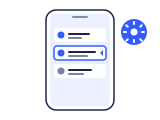
iPhone: Settings → Cellular. Android: Network → SIMs → Add eSIM.
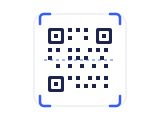
Point your phone at the QR on a second screen, or paste the activation code.
Name it “eSIM” so it’s obvious in your line picker.
Toggle the eSIM line on as you land. Data works on the jet bridge.
All major current iPhone, Android, and Google Pixel models support eSIM. Sweden’s operators use standard European LTE bands (B1, B3, B7, B20, B28) and 5G sub-6GHz (n1, n3, n28, n78), which are compatible with all eSIM-capable phones manufactured for European, North American, and Australian markets.
XS, XR, 11, 12, 13, 14, 15, 16 & SE (2nd gen+)
Yes. Dual SIM Dual Standby (DSDS) phones run both profiles simultaneously: the Sweden eSIM handles mobile data while your home SIM remains active for incoming calls, SMS, and two-factor authentication codes from banking apps. Installing your Sweden eSIM before departure and switching the data line to it in settings is all that is required on arrival.
The practical benefit in Sweden is significant. Swedish transit tickets, restaurant booking confirmations, museum QR codes, and ride-hailing apps all require a live data connection in real time. The Sweden eSIM handles all of this locally at Swedish data rates, while your home number stays reachable for contacts back home without incurring international call charges. Using the SL app for Stockholm metro navigation, the Västtrafik app for Gothenburg trams, and the Waxholmsbolaget app for archipelago ferries all run on the Sweden eSIM data line without consuming home SIM roaming allowance.
The most common dual-SIM mistake travelers make in Sweden is forgetting to disable data roaming on the home SIM line before arrival. If data roaming is left enabled on the home SIM, the phone may intermittently switch data to the home SIM when the Sweden eSIM signal fluctuates, triggering carrier roaming charges that arrive as a surprise bill after the trip. Go to your phone settings, disable data roaming on the home SIM line, and confirm the Sweden eSIM is set as the default data line before leaving the departure airport.
A Stockholm, Gothenburg, and Malmö rail trip uses data steadily because the traveler checks SL, SJ, Västtrafik To Go, Skånetrafiken, maps, QR tickets, restaurants, and hotel messages throughout the day. Data use rises quickly when the route adds archipelago ferries, a Gotland crossing, Lapland weather checks, aurora forecasts, or hotspot work from trains and cabins.
For Sweden, choose the bundle around the trip shape rather than the country name. City breaks need less data than remote-work stays, winter Lapland trips, rental-car routes through Dalarna or Jämtland, or family trips where one phone shares hotspot.
Activity | Avg rate | Intensity | 7–14 day total |
|---|---|---|---|
Google Maps + navigation | 50 MB/hr | ~3 GB 5 hr/day × 7 days | |
Instagram, TikTok, social | 700 MB/hr | ~10 GB 1 hr/day × 14 days | |
YouTube / Netflix (480p) | 550 MB/hr | ~8 GB 1 hr/day × 14 days | |
Work calls + email | 200 MB/hr | ~4 GB 2 hr/day × 10 days | |
iMessage, WhatsApp, light | 10 MB/hr | <1 GB Background use |
Buying before departure is the better default for Sweden because the first practical decisions often happen before the traveler reaches the city. At Stockholm Arlanda, Göteborg Landvetter, Malmö Airport, Kiruna, and Luleå, mobile data helps with airport buses, trains, taxis, live arrivals, hotel directions, and messaging as soon as the phone reconnects. Comparing Sweden eSIM plans, choosing the right network partner, and installing the Sweden eSIM on home WiFi means your eSIM is ready before the arrival-day queue begins.