
eSIM plans for Argentina
Compare 1518 live offers from 17 providers. Prices update every 12 hours.
218
offers shown
$0.52
cheapest
$0.69
best $/GB




Couldn't load the full plan list. Showing top plans only — please try again.

Find the best-fit eSIM for Argentina. Simple filters, clear comparisons, faster decisions.
Compare 1518 live offers from 17 providers. Prices update every 12 hours.







An Argentina eSIM is a digital SIM profile that connects your phone to Personal, Claro, or Movistar depending on the plan you choose, activated by QR code before you board without touching a physical card. This page ranks the best eSIM for Argentina across eight providers so you arrive at Ezeiza (EZE) or Aeroparque (AEP) with mobile data already live, travel health insurance documented per Argentina’s July 2025 entry rules, and every Argentina eSIM plan comparison done before departure.
eSIM for travel to Argentina eliminates the SIM kiosk queue, the ID requirement for local SIM purchases, and the wait for a data signal on the curb outside Ezeiza. The Argentina eSIM card installs in five minutes on home WiFi and is live before takeoff.
eSIM (embedded SIM) — a digital SIM profile installed via QR code or app (no physical card) used to connect a compatible phone to a mobile network. In Argentina, it connects to Personal, Claro, or Movistar depending on the plan you choose.
Argentina’s arrival flow rewards preparation. Most international visitors land at Ministro Pistarini International Airport (Ezeiza, EZE), located 35 km southwest of Buenos Aires, where the ride-share pickup point is outside the terminal and requires an active data connection from the moment you clear customs. Buying and installing the Argentina eSIM card at home on WiFi and activating it on touchdown means your Cabify or Uber is already queued before you reach the curb. Your home SIM stays active throughout for calls and SMS, so nothing breaks while the eSIM handles data.
On cost, most travelers save 60 to 90 percent compared to carrier roaming rates and pay roughly the same as a local Argentine prepaid plan, without the queuing at kiosks or the ID requirements that complicate local SIM purchases for foreign passport holders. In Buenos Aires, data needs are immediate: Google Maps to navigate the Palermo or San Telmo grid, the SUBE card top-up via MercadoPago, Cabify or DiDi for airport transfers and late-night rides, PedidosYa for food delivery, and WhatsApp for tour operators, restaurant bookings, and accommodation contacts throughout the country.
Argentina draws travelers across an enormous range of itinerary types, from a long weekend in Buenos Aires to a three-week Patagonia circuit. Our methodology weights price per GB, network partner quality, population and geographic coverage, activation speed, hotspot support, and customer support responsiveness across the provider whitelist.
Price per GB
Median price per GB across eligible provider plans, weighted toward common traveler data sizes.
Network coverage
Population and geographic coverage across major cities, tourist regions, transit routes, and rural areas.
Network partner
Activation speed
QR-code-to-data time. Most providers under 2 minutes; some require app install.
Hotspot support
Tethering allowed on all plan tiers without extra fees or fair-use throttling.
Customer support
24/7 chat availability, response time, and refund track record on canceled trips.
Argentina is well-served by the major eSIM providers. The eight providers below all support at least one of the three Argentine mobile networks and offer plans that fit the range of Argentina trip types, from a short Buenos Aires city break to a multi-week Patagonia circuit.




The best eSIM for Argentina overall is the plan that balances network partner quality, data volume, validity window, hotspot availability, and cost per GB for the itinerary you are actually running. The six criteria we score are: price per GB across the plan’s common data sizes, the strength and geographic reach of the Argentine network partner, activation simplicity, hotspot support for working from a Palermo cafe or a remote Patagonian estancia, customer support quality, and overall value density.
Best for: First-time visitors to Buenos Aires, backpackers doing the Iguazu-Buenos Aires-Mendoza-Patagonia circuit, digital nomads settling into Palermo for a month, and travelers who need reliable data from the moment they walk off the jet bridge at Ezeiza.
Light travelers in Buenos Aires and provincial cities often use 300 to 500 MB per day, covering maps, messaging, social uploads, and browser searches. Regular tourists doing multi-city circuits with daily navigation, WhatsApp voice calls to tour operators, and occasional social video tend to use 700 MB to 1.5 GB per day.
Heavier users doing video calls, uploading drone footage from Perito Moreno or Iguazu Falls, or running a hotspot for a laptop in a coworking space in Palermo or Mendoza should compare plans above 20 GB and verify hotspot is explicitly supported. Argentina spans over 3,700 km from north to south, so anyone covering Jujuy in the north, Buenos Aires in the center, and Ushuaia in the south on a single trip needs a plan with genuine nationwide coverage, not just metro-area reach.
The best overall Argentina eSIM plan covers all six scoring criteria. Coverage, validity, data volume, hotspot support, activation quality, and cost per GB must all clear the bar for a plan to rank near the top. Check the live table for current rankings, pricing, and plan details.
For a budget-focused traveler, the next section covers the best value options.
Argentina eSIM plans at the lower end of the price range still need a capable network partner to be genuinely useful. A best-value Argentina eSIM card is not simply the lowest number, it is the plan that delivers the most usable GB per dollar while keeping the network partner credible and the activation simple. Buenos Aires has excellent WiFi in most accommodation and many cafes, which makes a lighter plan viable for a city-only trip. The calculus changes once you leave the capital: the route from Buenos Aires to Mendoza by overnight bus, the transfer from El Calafate to the Perito Moreno car park, or a boat trip to Isla Martin Garcia all demand mobile data that does not rely on cafe WiFi.
Best for: Backpackers doing a Buenos Aires city stay of 3 to 5 days, budget travelers on the Gringo Trail between Buenos Aires and Mendoza, short-stay visitors arriving for a business trip to the CBD, and travelers who primarily use hostel or cafe WiFi and only need mobile data for navigation and WhatsApp.
Localized budget scenarios to keep in mind: navigating the Subte without a paper map requires constant data; ordering through PedidosYa or Rappi for delivery to your Airbnb uses modest background data. WhatsApp calling your tango lesson instructor or a local guide is light but needs a live connection. In the northern provinces of Salta and Jujuy, where accommodation WiFi is less consistent than in Buenos Aires, a value plan can become a poor fit if the data ceiling is too low for even light navigation use across multi-day routes.
The best value Argentina eSIM plan should still clear three practical minimums: a reputable network partner (Personal or Claro for reliable coverage), enough validity to cover the full stay, and hotspot support if you need to share data with a tablet or laptop. Plans that sacrifice coverage for a slightly lower price per GB are a poor trade on a country the size of Argentina.
For travelers focused on a specific trip window, the short-trip section below addresses that directly.
A 5-to-7-day Argentina eSIM does not need to be a large plan, but it does need to cover the most data-intensive moments of a short trip: navigating from Ezeiza to your accommodation on arrival, daily Subte and colectivo navigation in Buenos Aires, posting to Instagram from the Recoleta Cemetery or La Boca’s Caminito, and WhatsApp voice calls to local guides or restaurant reservations. A 1 to 3 GB plan can work for a light short trip with consistent hostel or hotel WiFi; a 3 to 5 GB plan is safer for anyone using maps continuously, uploading photos daily, or doing a day trip to Colonia del Sacramento via the Buquebus ferry.
Best for: Travelers doing a Buenos Aires weekend-plus, couples combining a Mendoza wine tour with two nights in the city, visitors flying into EZE for a business conference and a day trip to Tigre, and tourists using Aeroparque (AEP) for a Bariloche ski break in July.
Short-trip travelers arriving at Ezeiza benefit from 5G coverage in Buenos Aires if their device supports it. Personal has the broadest 5G footprint in the Buenos Aires metro, and Claro’s 5G network launched in 2025 adds a second strong option in the city and greater Buenos Aires area.
Daily or fixed-validity plans fit short Argentina itineraries well because they match the travel window without requiring a 30-day monthly commitment. For a Buenos Aires-only short trip, 5G availability on Personal or Claro makes a noticeable speed difference in dense neighborhoods like Palermo, Belgrano, and Recoleta. For anyone extending the short trip to include Iguazu Falls or a Mendoza day tour, verify your plan’s validity covers travel days in both directions.
The long-stay section below addresses travelers staying three weeks or more.
A 21-to-30-day Argentina eSIM needs to handle everything: daily navigation across multiple cities, WhatsApp as a primary communication tool, PedidosYa food delivery lookups, MercadoPago QR payment confirmations at shops and restaurants, Cabify and DiDi ride-hailing, and for remote workers, hotspot for laptop use in coworking spaces or Airbnbs without reliable WiFi.
Argentina’s long-stay travel pattern typically follows one of two routes: a Buenos Aires base with regional day trips and weekend escapes, or a sequential circuit moving from the capital through Cordoba, Mendoza wine country, the Andean northwest (Salta, Jujuy, Purmamarca), Iguazu Falls, and then back south toward Patagonia.
Best for: Digital nomads coworking from Palermo or Villa Crespo in Buenos Aires, slow travelers doing a complete Argentina circuit from Jujuy to Ushuaia, expatriates arriving on exploratory visits, students spending a semester in Cordoba or Rosario, and wine-focused travelers doing extended Mendoza and Salta stays.
Regular long-stay travelers often use 20 to 30 GB per month if they rely on mobile data for maps, messaging, and social media. Remote workers running a hotspot for laptop use can easily reach 50 GB per month or more, especially if video calls on Zoom or Google Meet are part of the daily routine.
For a Patagonia circuit covering El Calafate, El Chalten, Torres del Paine day trips, and Bariloche, Claro’s network advantage in remote southern Argentina becomes a practical consideration when choosing a plan.
The key trade-off on long-stay Argentina eSIM plans is between buying a single large fixed plan upfront versus a smaller plan with the intent to add a top-up. A single plan with 20 to 30 GB and 30-day validity is simpler and avoids the risk of running out at an inconvenient moment in a remote area. Hotspot support matters considerably more on long stays.
For travelers who need genuinely unlimited data throughout Argentina, the next section addresses unlimited plans.
Unlimited Argentina eSIM plans are genuinely useful in a specific set of scenarios where data consumption goes well above what a fixed plan covers. A full day at Los Glaciares National Park near El Calafate, staying in a cabin with no WiFi and sharing a hotspot for two devices doing video calls and map navigation, is exactly the situation where unlimited plans earn their price. Argentina’s accommodation outside Buenos Aires varies widely in WiFi quality, from Andean guesthouses in Mendoza’s Valle de Uco and estancias in Patagonia to cabanas in Bariloche and lodges near Iguazu, and unlimited plans eliminate the anxiety of watching data burn down in places where a top-up is not easy to arrange.
Best for: Remote workers running video calls from Buenos Aires coworking spaces, travelers doing extended Patagonia road trips where hotel WiFi is absent, content creators uploading large video files from Iguazu Falls or Perito Moreno, groups sharing a single hotspot across multiple devices, and digital nomads living in Argentina for 30-plus days with heavy daily data requirements.
Business travelers doing back-to-back days in Buenos Aires on Zoom or Teams, or traveling across multiple provinces in a week, benefit from the predictable cost of an unlimited plan even if daily consumption stays moderate. Practical data rates to anchor expectations: video calls on WhatsApp or Zoom consume approximately 500 MB to 1.5 GB per hour depending on quality settings; HD video streaming runs 1 to 3 GB per hour; a full coworking day running background cloud sync, occasional video calls, and normal browser use can reach 5 GB or more.
For unlimited plans, the fair-use policy is the most important clause. Most providers throttle speeds above a daily cap, commonly 1 to 2 GB, to a reduced rate that remains usable for messaging and maps but becomes frustrating for video. Read the fine print on throttle thresholds before purchasing, particularly for hotspot use.
Unlimited Argentina eSIM plans are often unnecessary for average tourists doing 10 to 14 days in Buenos Aires, Mendoza, and one or two national park destinations. A 15 to 20 GB fixed plan typically covers that itinerary comfortably. Unlimited plans are the right choice when the itinerary includes remote areas without WiFi, when a hotspot is shared across multiple devices, or when video calls are a daily requirement. Daily throttle limits vary significantly between providers.
For a full picture of where coverage holds and where it thins out, the next section covers Argentina’s mobile network in detail.
Argentina’s mobile network landscape is defined by three nationally licensed operators, Personal, Claro, and Movistar, each with a distinct geographic strength profile that directly shapes which network partner to prioritize when choosing an Argentina eSIM plan.
Personal (Telecom Argentina) leads Argentina’s mobile network on speed and urban reliability. According to SpeedGEO data covering April 2025 to March 2026, Personal delivers an average mobile download speed of 62.8 Mbps nationally, ahead of Claro at 42.6 Mbps and the all-provider average of 47.0 Mbps. In Buenos Aires, Personal’s mobile speeds reach 123.4 Mbps average download with a 24 ms latency. Personal also holds Opensignal’s Coverage Experience award for Argentina. Its 5G Standalone network launched in the Buenos Aires Metropolitan Area (AMBA) in February 2021 and has since expanded to Cordoba and Rosario, with 260 sites deployed by end-2024. In the northern tourist corridors including Salta, Jujuy, and Puerto Iguazu, Personal and Claro perform at near-equivalent levels, while Movistar shows noticeably weaker connectivity on roads and in smaller towns.
Claro (America Movil) is Argentina’s specialist for rural and remote coverage. While its city speeds average 42.6 Mbps nationally, Claro’s geographic advantage becomes decisive once the route leaves the main urban corridors. In Patagonia, covering El Calafate, El Chalten, Bariloche, and the roads between them, Claro is consistently cited by independent testing as the operator with signal in locations where Personal drops out. In El Chalten, Argentina’s hiking capital at the foot of the Fitz Roy massif, traveler testing as recently as 2025 shows Claro maintaining connectivity where Personal is absent. Claro launched its 5G infrastructure in 2025 using Nokia equipment, with initial coverage in Buenos Aires, Cordoba, and Rosario. Its nationwide 4G LTE footprint covers urban centers, provincial capitals, and a substantial share of tourist routes including the Ruta 40 corridor through the Andean west.
Highway coverage along Ruta Nacional 7 (Buenos Aires to Mendoza), Ruta 9 (Buenos Aires to Cordoba and Jujuy), and Ruta 3 (Buenos Aires to Ushuaia through Patagonia) is generally reliable on Personal and Claro in populated sections but becomes variable on long open stretches between towns. The Buenos Aires Subte (metro) is a specific case: in-station WiFi is available, but mobile signal between stations in tunnels is inconsistent across all three operators. The Mitre, Sarmiento, San Martin, and Roca train lines connecting Buenos Aires city with Greater Buenos Aires maintain good above-ground 4G throughout.
Patagonia, the Andes, and remote tourist regions present the most variable coverage in Argentina. In Los Glaciares National Park, signal near El Calafate town and the Perito Moreno glacier visitor area is generally available on Claro and Personal, but drops off on hiking trails deeper into the park. Tierra del Fuego and Ushuaia are served by all three operators in town, but Ruta 3 south of Rio Grande has long gaps with no signal. In the northwest provinces, particularly Jujuy’s Quebrada de Humahuaca, the altiplano of Salinas Grandes, and the mountain roads between Purmamarca and Tilcara, Claro holds the most consistent 4G in small towns, with all three operators providing good coverage in Salta city itself.
The practical implication for Argentina eSIM plan selection is this: travelers doing a Buenos Aires-only or Buenos Aires-plus-urban-circuit trip can choose any provider with Personal or Claro as a network partner and get excellent coverage. Travelers building an itinerary that includes Patagonia, Tierra del Fuego, El Chalten, the Quebrada de Humahuaca, or long Ruta 40 drives should specifically select a plan that partners with Claro for its demonstrably stronger remote-area performance. The network partner is chosen by the eSIM provider, not by the traveler directly, so check the partner column in the live table.
| Network Name | Coverage Level | 4G LTE Coverage | 5G Population | Urban Reliability | Rural Reliability |
|---|---|---|---|---|---|
| Personal (Telecom Argentina) | Nationwide | ~95% population | ~9-12% (AMBA + major cities) | High (~90%+) | Moderate–High |
| Claro (America Movil) | Nationwide + best rural | ~94% population | Expanding (BA, Cordoba, Rosario, 2025) | High (~88%+) | High (Patagonia, Andes) |
| Movistar (Telefonica) | Nationwide (urban-strong) | ~92% population | Selective urban (launched 2024) | High in cities | Moderate |
Personal is the top choice for Buenos Aires-focused itineraries and northern circuits where raw speed and 5G access matter most. Claro is the network of choice for Patagonian routes, national park access, and itineraries that include El Chalten, El Calafate, Ushuaia, or long Ruta 40 sections. Movistar offers solid urban 4G across all provincial capitals but thins out noticeably on rural roads.
Argentina eSIM plans work reliably across all four major cities, but performance characteristics differ by city and by network partner. In Buenos Aires, signal is strong throughout the central barrios: Palermo, Recoleta, San Telmo, La Boca, Puerto Madero, Microcentro, Belgrano, and Villa Crespo all deliver consistent 4G from all three operators, with 5G available on Personal and Claro in the denser urban corridors. Mobile data in Buenos Aires is used for everything.
Subte navigation, Cabify or DiDi hailing, MercadoPago QR payments, PedidosYa food delivery, Google Maps navigation, WhatsApp with tour guides, and booking.com messaging. Ezeiza Airport (EZE) and Aeroparque (AEP) both have strong coverage across all operators in the terminal buildings and approach roads.
In Cordoba, Personal and Claro both deliver strong 4G throughout the city center, Nueva Cordoba university district, and the Paseo del Buen Pastor tourist precinct. 5G is live in Cordoba’s central districts on Personal and expanding on Claro. Rosario has excellent 4G coverage on Personal and Claro across the Costanera riverside area, the Mercado del Patio cultural zone, and the Che Guevara birthplace heritage sites. Mendoza is well-covered on all three operators in the city center, but Personal and Claro are notably stronger in the Valle de Uco wine route southwest of the city and in the road approaches to the Aconcagua base camps.
Data
Best network
Personal
Median speed
Latency
24 ms
Data
Personal/Claro
~40 ms
Data
Personal/Claro
~42 ms
Data
Claro/Personal
~45 ms
Beyond these four cities, coverage extends across a wide range of additional tourist destinations. Salta city has strong 4G from all three operators. San Miguel de Tucuman, Mar del Plata on the Atlantic coast, Bariloche in the Lake District, and Puerto Madryn (gateway to Peninsula Valdes whale watching) all have dependable 4G from Personal and Claro in their urban areas.
Puerto Iguazu has solid 4G from Personal and Claro in town and at the national park visitor entrance, though signal thins at the more remote cataratas viewpoints. El Calafate town has coverage from all operators; the Perito Moreno glacier access road maintains a signal for most of the route on Claro.
5G in Argentina is currently strongest in the Buenos Aires Metropolitan Area, with meaningful deployments also in Cordoba and Rosario. Two coverage caveats worth noting for Argentina specifically: the Buenos Aires Subte tunnels between stations drop mobile signal on all operators, and national park trails in Los Glaciares and Tierra del Fuego National Park move beyond the edge of practical mobile coverage beyond the visitor infrastructure zones.
Using an eSIM in Argentina is straightforward for most travelers, but four practical considerations are worth understanding before departure.
Device compatibility is the most common friction point. Not all phones support eSIM, and older devices that technically support eSIM may not activate all plans correctly. iPhones from the iPhone XS (2018) onward and most Android flagships from 2019 onward support eSIM. If your phone is carrier-locked, check with your home carrier first. A locked device will reject eSIM profiles from other providers regardless of compatibility. This is worth confirming before leaving home rather than at 2 AM in a Buenos Aires Airbnb with no WiFi fallback.
Argentina’s new travel health insurance requirement adds a documentation task, not a data task. Since July 1, 2025, all foreign visitors must show proof of health insurance at entry (Decree DNU 366/2025). This document check happens at immigration, not at a SIM kiosk, so your eSIM plan is unaffected. But the practical implication is that your phone needs to be working before immigration to display your insurance documentation digitally. Installing the Argentina eSIM card before departure means your phone is live before you reach the immigration desk.
Dual SIM use has a specific Buenos Aires frequency band nuance. Argentina uses Band 28 (700 APT) and AWS (1700/2100 MHz) for 4G LTE, bands that most US, Canadian, and Australian devices support natively. Some European and Asian market devices may operate only on 2G/3G unless Band 28 is supported. If you are using a European SIM-market device, check band compatibility for Argentina before purchasing an eSIM plan.
Data roaming on your home plan is not a replacement for a local eSIM. Argentina’s mobile data costs through international carrier roaming can exceed $10 to $15 USD per day on many home-country plans. Switching off data roaming on the home SIM and running exclusively on the eSIM plan avoids the bill shock that is a commonly reported issue for travelers who assume their home plan covers South America economically.
Most Argentina eSIM plans are activated in two steps: purchase and download the QR code before travel, then scan it from your phone’s eSIM settings while connected to WiFi. The eSIM profile installs in minutes, and the plan activates automatically when your phone registers on the Argentine network on arrival. We recommend installing at home or at the departure airport, not at Ezeiza arrivals where WiFi coverage in the arrivals hall is inconsistent.

Pick a plan, pay, get a QR code by email within ~60 seconds.

iPhone: Settings → Cellular. Android: Network → SIMs → Add eSIM.
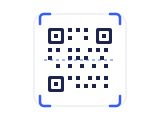
Point your phone at the QR on a second screen, or paste the activation code.

Name it “eSIM” so it’s obvious in your line picker.
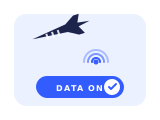
Toggle the eSIM line on as you land. Data works on the jet bridge.
Argentina’s networks use Band 28 (700 APT) and Band 4 (AWS 1700/2100 MHz) for 4G LTE. Most modern smartphones from 2019 onward support both eSIM and the relevant Argentine frequency bands. For European-market devices, confirm Band 28 support before purchasing an Argentina eSIM plan.
XS, XR, 11, 12, 13, 14, 15, 16 & SE (2nd gen+)
Argentina’s mobile networks fully support Dual SIM Dual Standby (DSDS) operation on compatible devices. This means your Argentina eSIM for data runs simultaneously with your home SIM staying live for calls and SMS. The Argentina eSIM handles all data tasks while your home number receives calls and texts from contacts who do not have your local number.
The practical benefit in Argentina is meaningful. Your home SIM stays live for two-factor authentication SMS from banking apps, calls from family or work that come in on your home number, and any services that require your registered home number. The Argentina eSIM handles all data-heavy tasks: navigating between Puerto Madero and Palermo in Buenos Aires, calling tour operators via WhatsApp from Ushuaia, loading trail maps in Los Glaciares National Park, and running a hotspot for a travel companion on a long bus journey from Buenos Aires to Mendoza on Ruta 7.
One common mistake travelers make in Argentina with dual SIM: leaving mobile data enabled on the home SIM by accident. When both SIMs are active and the home SIM has data roaming turned on, the phone may default to the home SIM for certain background data requests, generating unexpected roaming charges. Before landing in Argentina, set the Argentina eSIM as the default data SIM, and confirm mobile data is disabled on the home SIM specifically.
A 10-to-14-day Argentina itinerary typically combines Buenos Aires city navigation with at least one regional destination: Mendoza wine routes, the Iguazu Falls circuit in Misiones, an El Calafate and Perito Moreno glacier visit, or a Salta and Quebrada de Humahuaca loop. Each phase has distinct data requirements: the Buenos Aires days involve dense app use (Subte navigation, Cabify, MercadoPago, WhatsApp) while regional days shift toward Google Maps for road navigation, offline map downloads for national parks, and photo uploads over hostel WiFi.
Activity | Avg rate | Intensity | 7–14 day total |
|---|---|---|---|
Google Maps + navigation | 50 MB/hr | ~3 GB 5 hr/day × 7 days | |
Instagram, TikTok, social | 700 MB/hr | ~10 GB 1 hr/day × 14 days | |
YouTube / Netflix (480p) | 550 MB/hr | ~8 GB 1 hr/day × 14 days | |
Work calls + email | 200 MB/hr | ~4 GB 2 hr/day × 10 days | |
iMessage, WhatsApp, light | 10 MB/hr | <1 GB Background use |
Installing the best eSIM for Argentina before departure is the practical choice, and the arrival context at Ezeiza makes this especially clear. Ministro Pistarini International Airport (EZE) is located 35 km from Buenos Aires city center, and the journey by remis, taxi, or ride-share takes 40 to 60 minutes depending on traffic.
Securing a Cabify or Uber from inside the terminal requires mobile data before you step outside. Airport WiFi at EZE exists in the departure and arrivals halls, but connectivity is inconsistent in the customs and baggage hall where you will have the most time to wait. Argentina’s July 2025 health insurance entry requirement (DNU 366/2025) also means having your phone working before you reach the immigration desk is more useful than ever.
Comparing Argentina eSIM plans at home, choosing the right eSIM for your itinerary, and installing the eSIM before the flight means you are ready before the wheels touch the runway at EZE. eSIM for travel to Argentina is the practical standard for travelers who want the first hour to be smooth rather than stressful.