
eSIM plans for Czechia
Compare 1907 live offers from 17 providers. Prices update every 12 hours.
240
offers shown
$0.20
cheapest
$0.29
best $/GB



Couldn't load the full plan list. Showing top plans only — please try again.

Find the best-fit eSIM for Czech Republic. Simple filters, clear comparisons, faster decisions.
Compare 1907 live offers from 17 providers. Prices update every 12 hours.










A Czech Republic eSIM is a digital SIM profile that connects your phone to the networks of T-Mobile, O2, or Vodafone the moment you clear passport control at Václav Havel Airport Prague, the landlocked country’s single dominant international gateway handling 92% of all foreign arrivals.
This page compares Czech Republic eSIM plans across eight verified providers, ranking each by network partner strength, price per GB, activation, hotspot support, and coverage across Prague, Brno, the Bohemian countryside, and the regional cities so you arrive with eSIM for travel to Czech Republic already active on your phone.
eSIM (embedded SIM): a digital SIM profile installed via QR code or app (no physical card) used to connect a compatible phone to a mobile network. In Czech Republic, it connects to T-Mobile, O2 Czech Republic, or Vodafone Czech Republic depending on the plan you choose.
Because virtually every international traveler enters the Czech Republic through Václav Havel Airport Prague (PRG), the arrival experience is predictable: a single terminal corridor, a growing queue at border control and then a bus or metro ride into the city.
Installing a Czech Republic eSIM before flying means your phone connects to a Czech network the moment you land, while your home SIM stays active for calls and two-factor SMS. Reliable data matters here: PID Lítačka requires a live connection to buy metro, tram, and bus tickets across Prague Integrated Transport zones. Apps like IDOS and Google Maps handle intercity trains and buses to Brno or Český Krumlov.
If you’re traveling from an EU or EEA country, however, your home SIM already works in the Czech Republic under Roam Like at Home (RLAH) rules at no extra cost, so a separate eSIM may not be necessary.
Czech Republic’s compact geography and high urban concentration mean that most travelers spend the majority of their trip in Prague and a handful of regional cities connected by České dráhy rail or RegioJet coaches. We weighted network partner quality and 5G urban performance heavily, because the gap between operators is most visible inside Prague’s metro tunnels, along the D1 motorway spine between Prague and Brno, and in the border-region mountain areas of Krkonoše and Šumava where rural coverage still varies.
Price per GB
Network coverage
Network partner
Activation speed
QR-code-to-data time. Most providers under 2 minutes; some require app install.
Hotspot support
Tethering allowed on all plan tiers without extra fees or fair-use throttling.
Customer support
24/7 chat availability, response time, and refund track record on canceled trips.
Following verified eSIM providers from our list of providers offer active Czech Republic plans compatible with T-Mobile, O2, and Vodafone networks. Provider availability and current plan ranges are confirmed through live platform checks.


Choosing the best eSIM for Czech Republic overall means matching six variables to your actual itinerary: price per GB, which local operator carries your data, the data volume needed for a city-heavy stay, validity matched to your trip length, hotspot support if you need it, and activation reliability. Czech Republic eSIM plans span a wide range in all six categories, and the live table below ranks the top eight across all of them.
Best for: First-time visitors to Prague spending 3–5 days covering the Old Town Square, Charles Bridge, Prague Castle, and Josefov, international business travelers flying into PRG for a conference at the Prague Congress Centre, and multi-city travelers planning a loop from Prague to Brno and Český Krumlov.
A classic Czech Republic itinerary for a first visit runs three days in Prague (using PID Lítačka for metro and tram, Bolt or Uber for the airport transfer from PRG, Google Maps or Mapy.cz for navigating Malá Strana and the back streets of Vinohrady), then a RegioJet or České dráhy train to Brno (2.5 hours on the D1 rail corridor) for a night at the Cabbage Market and the Špilberk Castle, and finally a bus to Český Krumlov for two nights before returning to Prague by FlixBus. On this 6–7 day loop, a 5–10 GB Czech Republic eSIM plan is typically sufficient, with data going primarily to PID Lítačka ticket purchases, navigation, IDOS connection lookups, and messaging.
Light travelers often use 300–500 MB per day for maps and messaging. Regular tourists navigating Prague‘s metro and tram system, looking up train connections, and uploading photos use 700 MB to 1.5 GB per day. Heavier users running hotspot or frequent video calls should compare larger bundles.
The best overall Czech Republic eSIM plans balance all six ranking criteria. Coverage quality matters most in the city-to-city travel layer: inside Prague’s metro tunnels (all 61 stations fully covered by all three operators since the CZK 500 million infrastructure project completed), along the D1 motorway between Prague and Brno, and across the regional bus corridors to Karlovy Vary and Plzeň. Check the live table for current pricing, then cross-reference the network partner against the coverage section below.
If cost per GB is the primary driver, the next section compares plans ranked specifically for value.
T-Mobile Czech Republic leads the country’s mobile network on overall download speed and rural performance, winning 12 out of 14 categories in Opensignal’s February 2025 Czech Republic Mobile Network Experience report — the most recent comprehensive independent assessment of the market.
T-Mobile’s national download speed experience score stands at 58.2 Mbps, which is 17 Mbps ahead of second-placed O2 Czech Republic at 41.6 Mbps, with Vodafone third at 29.4 Mbps. That speed gap is most visible across Prague’s broader metro area and along the D1 motorway between Prague and Brno, where T-Mobile’s modernized antenna infrastructure delivers consistent high-speed 4G and 5G across the full 376 km corridor.
O2 Czech Republic runs a competitive second, completing the main stage of its national 5G modernization in November 2024 with 5,300 base stations covering 96% of the Czech population, and specifically outperforming T-Mobile on mobile download speeds inside Prague city centre, where O2 reaches 224.2 Mbps per SpeedGEO city data from April 2025 to March 2026. Vodafone Czech Republic holds the broadest 5G population coverage percentage at 96.97% nationally and covers 100% of motorways and 99.87% of main railway lines with 5G per Czech Telecommunications Office data from February 2025.
The D1 motorway, the Czech Republic’s busiest road and the spine connecting Prague, Brno, and Ostrava across 376 km, carries full 5G and 4G coverage from all three operators, with Vodafone specifically claiming 100% motorway 5G coverage. The regional road networks west toward Plzeň (D5/E50), north into Ústí nad Labem, and south toward České Budějovice are similarly well-covered in the populated corridor sections.
The Czech rail network operated by České dráhy and RegioJet connects Prague Hlavní nádraží with Brno (2.5 hours) and Ostrava (3–4 hours); mobile coverage along these routes is strong in the open-country sections, though deep-cut valleys in Bohemian terrain and the approach tunnels into Prague Main Station can briefly affect signal.
Inside Prague itself, the entire metro network — Lines A, B, and C covering all 61 stations and their connecting tunnels — has been fully covered by all three operators since 2021/2023, the result of a CZK 500 million joint infrastructure project by T-Mobile, O2, Vodafone, and CETIN. This means riders have live mobile data from Depo Hostivař on Line A through Muzeum to Letňany on Line C, including the deepest platforms.
The Czech Republic’s rural coverage caveats are concentrated in three geographic environments. First, the Šumava (Bohemian Forest) national park along the German and Austrian border: the dense forested terrain and limited permanent settlements mean 5G penetration is shallow and 4G, while present, can be variable on the smaller forest roads between Kvilda, Modrava, and the forest valley trails.
Second, the Krkonoše (Giant Mountains) in the northeast, where the highest elevations above Špindlerův Mlýn and near Sněžka (the Czech Republic’s highest peak at 1,603 m) experience weaker signal on all networks due to terrain. Third, the border-region white spots along the former Iron Curtain, particularly in the Sudetenland districts of western Bohemia and northern Moravia, where post-war depopulation left large areas of low commercial viability for mobile infrastructure; the three operators signed a five-year EU-backed government agreement in June 2025 to build 5G coverage across 600 of these locations by 2030.
For travelers spending their entire Czech Republic visit in Prague, the network partner choice between T-Mobile, O2, and Vodafone has minimal practical impact; all three provide excellent 4G and 5G across the city, including inside the metro tunnels. The choice becomes relevant for travelers renting a car and driving into the Šumava, the Bohemian Paradise (Český ráj) rock formations, or the White Carpathians in eastern Moravia, where T-Mobile’s consistently superior rural and highway benchmarks translate to better real-world reliability. Travelers using only the D1 and the regional capitals can effectively rely on any of the three network partners.
| Network Name | Coverage Level | 4G LTE Coverage | 5G Population | Urban Reliability | Rural Reliability |
|---|---|---|---|---|---|
| T-Mobile Czech Republic | National speed leader | ~99% | ~93.4% | Very High | Very High |
| O2 Czech Republic | Strong nationwide | ~99% | ~96% | Very High | High |
| Vodafone Czech Republic | Broadest 5G footprint | ~97% | ~96.97% | Very High | Medium-High |
T-Mobile Czech Republic is the top overall choice for travelers leaving the main urban centres, with the strongest rural and highway performance.
O2 Czech Republic leads 5G download speed specifically in Prague city centre and has the broadest 4G rural reach nationally.
Vodafone Czech Republic leads 5G population coverage percentage and motorway coverage but trails T-Mobile on rural road performance.
A Czech Republic eSIM card activated before arrival works reliably in all four major cities, and the specific networks, infrastructure investments, and city-level data environments differ meaningfully between them. In Prague, all three operators provide dense 5G coverage across the city centre, including the Old Town Square, Wenceslas Square, Vinohrady, Žižkov, Karlín, and the entire metro network from Letňany on Line C to Depo Hostivař on Line A, including deep underground stations.
The practical use case in Prague is primarily PID Lítačka for transit tickets and validations, Google Maps or Mapy.cz for navigating the dense medieval street pattern in Staré Město and Malá Strana, Bolt or Uber for the trip from Václav Havel Airport to the city center or between neighborhoods, and Wolt for food delivery across the central districts.
In Brno, T-Mobile leads local mobile speeds at 126.3 Mbps per SpeedGEO data, and all three operators cover the city centre around the Cabbage Market (Zelný trh), Špilberk Castle, and the Brno Main Station intercity rail hub.
In Ostrava, coverage is solid across the city centre and the surrounding industrial districts, with data primarily used for navigation on the tram network and connections through Ostrava-Svinov hub.
In Plzeň, the tourist areas around the Pilsner Urquell Brewery, Republic Square (náměstí Republiky), and the main bus and rail station are fully covered.
Mobile data in these four cities is practically used for: PID Lítačka transit tickets across Prague metro, tram, and bus; IDOS and RegioJet for intercity train connections. Bolt or Uber can be used for airport transfers and city rides while Google Maps and Mapy.cz is better suited for navigation. For food delivery, Wolt or Bolt Food is the best choice in Prague and Brno, while booking apps are useful for accommodation and attraction tickets across all four cities.
Data
Best network
O2 / T-Mobile
Median speed
Latency
~23 ms
Data
T-Mobile
~31 ms
Data
T-Mobile / O2
~35 ms (proxy)
Data
T-Mobile / O2
~35 ms (proxy)
Beyond the four card cities, several additional Czech Republic destinations carry strong mobile coverage. Karlovy Vary, the northwestern spa town and venue of the international film festival, is well-served by all three operators across the Kolonáda hot spring promenade, the hotel strip, and the winding streets above the spa valley.
Český Krumlov, the UNESCO-listed medieval town in South Bohemia, has reasonable coverage across the castle complex and old town, though the narrow stone passages of the historic core can slightly attenuate indoor signal from 5G to 4G. Kutná Hora, the UNESCO-listed medieval silver-mining town east of Prague easily reached by regional train from Prague Hlavní nádraží, has adequate 4G coverage at the Sedlec Ossuary and St. Barbara’s Cathedral sites.
Olomouc in central Moravia has full city-centre coverage on all three operators. Telč, the small South Moravian UNESCO town, has coverage but at a lower density than the major cities. 5G from all three operators is strongest in Prague and Brno. 4G is the reliable fallback on the regional rail routes between Brno and Olomouc, through the forested sections of the Šumava, and on the mountain approach roads in Krkonoše above Špindlerův Mlýn.
Two realistic Czech Republic-specific coverage caveats: the tunnel sections between Prague metro stations can briefly interrupt streaming mid-journey, even though all 61 platforms are now covered — the connecting tunnels between stations remain the weak link. The mountain roads near Sněžka in Krkonoše above approximately 1,400 m elevation see signal degradation on all networks, making offline map downloads advisable before entering the high-altitude hiking zones.
Most concerns about Czech Republic eSIM plans are straightforward to address before departure. The four most relevant ones for this specific destination are worth knowing.
The Czech Republic uses the Koruna, not the Euro. This surprises many travelers combining a Czech Republic visit with other EU destinations. The Czech koruna (CZK) is the local currency, and eSIM providers price Czech Republic plans in USD or EUR, not CZK, so there is no local currency complication for the eSIM purchase itself. But it is worth remembering that your data plan does not affect local payment methods — apps like PID Lítačka charge in CZK via bank card rather than cash, which means the eSIM data connection powering the app is separate from the payment currency question.
EES border checks at Václav Havel Airport add time to arrivals. Since October 2025, non-EU visitors entering Václav Havel Airport Prague (PRG) are subject to biometric data collection at the border control point. Prague Airport itself flagged that this may cause longer waiting times. A pre-installed Czech Republic eSIM means your phone is already connected while you wait in the EES queue, which makes it significantly more useful than trying to install the eSIM after clearing a now-longer border control.
PID Lítačka requires consistent data, not just occasional connectivity. Prague‘s primary transit ticketing app validates tickets by generating a QR code that must be live at the point of inspection. Some travelers find that a weak or intermittent signal in metro entry areas causes the app to freeze during ticket validation. This is not a limitation of Czech Republic eSIM plans specifically, but it makes the case for choosing a plan with a strong network partner in Prague rather than the cheapest available option.
Device unlocking is the first step. A small proportion of phones purchased under contract in markets with slow eSIM adoption — certain US carriers, some Asian markets — may require carrier unlocking before a Czech Republic eSIM card can be installed. Confirming your phone’s eSIM compatibility and unlock status takes two minutes on the manufacturer’s website and eliminates the most common installation failure mode.
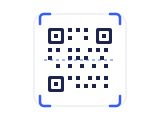
Czech Republic eSIM plans from all major providers activate via QR code or app install on home WiFi before departure. The standard process is: purchase the Czech Republic eSIM plan from your chosen provider, receive the installation QR code by email, install the profile on home WiFi, set the Czech eSIM as the active data SIM, and the profile connects automatically to T-Mobile, O2, or Vodafone on landing at Václav Havel Airport Prague.




All three Czech Republic mobile operators, T-Mobile, O2, and Vodafone, support eSIM on unlocked compatible devices. The compatible device list covers most smartphones released since 2019 from Apple, Samsung, Google, and other major manufacturers.
XS, XR, 11, 12, 13, 14, 15, 16 & SE (2nd gen+)
Dual-SIM operation is straightforward in Czech Republic and is the standard setup for most international travelers. The Czech Republic eSIM handles local mobile data on T-Mobile, O2, or Vodafone Czech networks, while the home SIM stays active for incoming calls, home-country SMS, and banking two-factor codes throughout the trip.
The practical benefit in Prague is particular to how the city works. Your home SIM number stays reachable for any incoming calls from contacts or services back home, while the Czech Republic eSIM handles PID Lítačka ticket purchases across Prague’s metro and tram network, IDOS lookups for Czech Railways and RegioJet connections, Bolt or Uber for rides between Vinohrady and Václav Havel Airport, and Wolt for delivery to your apartment in Žižkov. Dual-SIM also means any two-factor authentication codes from Czech travel booking sites arrive on the home SIM number while the eSIM keeps the booking app loaded and responsive.
The most common dual-SIM mistake in Czech Republic is specific to the PID Lítačka app: the app requires an active mobile data connection at the moment of ticket validation, and travelers who accidentally revert to home-SIM roaming data during metro use may find the roaming connection slower or less reliable than the Czech eSIM connection. Setting mobile data to the Czech eSIM in the phone settings before landing — which takes under 30 seconds — prevents this, and checking once more before the first PID Lítačka ticket purchase at Václav Havel Airport metro bus stop is a sensible precaution.
Most Czech Republic trips are Prague-centric, and data use in Prague is shaped by three things specific to the city: PID Lítačka transit ticketing (which requires brief but reliable data connections multiple times per day), navigation through a dense medieval street grid where GPS and offline maps together consume moderate data, and Bolt or Uber for airport and late-night transfers where a dropped connection mid-booking is genuinely inconvenient. Adding Brno or Český Krumlov as a day trip or overnight means IDOS or RegioJet booking data and rural navigation on the approach roads between those cities.
Activity | Avg rate | Intensity | 7–14 day total |
|---|---|---|---|
Google Maps + navigation | 50 MB/hr | ~3 GB 5 hr/day × 7 days | |
Instagram, TikTok, social | 700 MB/hr | ~10 GB 1 hr/day × 14 days | |
YouTube / Netflix (480p) | 550 MB/hr | ~8 GB 1 hr/day × 14 days | |
Work calls + email | 200 MB/hr | ~4 GB 2 hr/day × 10 days | |
iMessage, WhatsApp, light | 10 MB/hr | <1 GB Background use |
Before you fly. Buying and installing a Czech Republic eSIM card before departure is the strongly recommended approach given the specific nature of Václav Havel Airport Prague (PRG) as a single dominant gateway. PRG is a compact two-terminal airport located 18 km from the city centre, and non-EU travelers since October 2025 are subject to EES biometric data collection at the border control point, which can extend queue times during peak morning arrivals.
The airport does sell local SIM cards in the arrival halls, but finding the right counter, activating a physical card, and registering it while tired from a long flight is avoidable with five minutes of preparation at home. A pre-installed Czech Republic eSIM means Bolt or Uber for the airport transfer is ready the moment you clear customs, the PID Lítačka app can begin recognizing your data connection before you reach the No. 119 bus stop, and you are not dependent on the terminal’s public WiFi to complete an eSIM download for the first time.