eSIM plans for Namibia
Compare 0 live offers from 0 providers. Prices update every 12 hours.
0
offers shown
—
cheapest
—
best $/GB
Couldn't load the full plan list. Showing top plans only — please try again.

Find the best-fit eSIM for Namibia. Simple filters, clear comparisons, faster decisions.
Compare 0 live offers from 0 providers. Prices update every 12 hours.

A Namibia eSIM installs before departure and activates the moment the plane touches down at Hosea Kutako International Airport, so a rental vehicle can be collected and a route to Etosha National Park or Sossusvlei mapped out without hunting for a SIM counter first. This page compares the best eSIM for Namibia across coverage, validity, and data allowance, so choosing the right Namibia eSIM plans for a self-drive route through the Namib Desert and eSIM for travel to Namibia along the Skeleton Coast is settled before the flight, with the Namibia eSIM card already installed and ready.
eSIM (embedded SIM) is a digital SIM profile installed via QR code or app, with no physical card involved, that lets a compatible phone connect to a mobile network. In Namibia, it connects to MTC or TN Mobile depending on the plan chosen.
Buying and installing a Namibia eSIM before flying means the network is active the moment the plane lands. Arrival at Hosea Kutako International Airport sits roughly 45 minutes outside Windhoek, and most visitors head straight for a rental counter to start a self-drive route rather than lingering at the terminal. A working Namibia eSIM card at that point means route mapping to Etosha or the B1 highway can start immediately, while the home SIM stays active for calls and SMS.
Offline navigation apps such as Tracks4Africa and Maps.me rely on downloaded maps, but live data still matters for booking confirmations at lodges, WhatsApp check-ins with tour operators, and checking road conditions before entering Etosha or the Namib-Naukluft gravel routes.
We compared Namibia eSIM plans on price per GB, network coverage across the island and its smaller neighbours, network partner reliability, activation speed, and hotspot support.
Price per GB
Median price per GB across eligible provider plans, weighted toward common traveler data sizes.
Network coverage
Population and geographic coverage across major cities, tourist regions, transit routes, and rural areas.
Network partner
The local mobile operator used by each plan, scored by coverage strength, reliability, and 4G or 5G availability.
Activation speed
QR-code-to-data time. Most providers under 2 minutes; some require app install.
Hotspot support
Tethering allowed on all plan tiers without extra fees or fair-use throttling.
Customer support
24/7 chat availability, response time, and refund track record on canceled trips.
A range of established eSIM brands sell Namibia-covering plans, each riding on one or more of the country’s mobile networks. Compare current options below.




Namibia is not a short city-break destination, so the best eSIM for Namibia overall is judged against a different traveler than the ones typical European or Southeast Asian pages assume.
Best for: Self-drive safari travelers, wildlife photographers, and overlanders covering Windhoek, Etosha National Park, Sossusvlei, and the Skeleton Coast over one to two weeks, rather than a single-city visitor. The best overall pick weighs six factors: price, network coverage, partner network strength, activation speed, hotspot support, and provider customer support. Providers such as Airalo, Saily, Nomad, and Maya Mobile are commonly compared against these criteria without a single winner being fixed in advance.
A representative Namibia itinerary runs from Windhoek south to Sossusvlei and Sesriem, west to Swakopmund and Walvis Bay on the coast, then north through Damaraland to Etosha National Park, covering desert, coastal, and savanna coverage environments in the same trip. Light travelers checking maps and messages often use 300 to 500 MB per day, regular travelers uploading photos and streaming occasional video use 700 MB to 1.5 GB per day, and anyone editing or backing up wildlife photography in bulk should compare larger data bundles.
The best overall Namibia eSIM plan balances coverage on the routes actually driven, validity long enough for a full loop, a data allowance sized to the trip, hotspot support for a second device, and a straightforward activation flow at the airport. The live comparison table below ranks current options against these criteria. Since data allowance matters more than price alone on a long self-drive loop, the next question is which plan actually delivers the best value per gigabyte.
MTC is Namibia’s strongest network by nationwide footprint and remains the most recommended operator for travelers, with the deepest reach into Etosha National Park, the Skeleton Coast, and remote stretches of the Namib Desert. TN Mobile operates a smaller, newer network that performs reliably in Windhoek, Swakopmund, and other major towns, but its rural footprint trails MTC outside those centers.
On the road, coverage tracks the country’s main highways rather than following travelers everywhere at once. The B1 corridor connecting Windhoek, Okahandja, and Otjiwarongo toward Etosha carries a dependable 4G signal for most of its length, and the tarred route between Windhoek and Swakopmund via the Khomas Hochland also stays connected. Once vehicles turn onto gravel routes toward Sossusvlei, the Sesriem area, or deep into Damaraland, signal becomes intermittent and drops out entirely for long stretches between towns.
Namibia’s low population density means large parts of the country simply sit outside any tower’s range, a reality distinct from its neighbors. Inside Etosha National Park, coverage exists mainly around the main camps at Okaukuejo, Halali, and Namutoni, while game-drive loops further from camp often lose signal. The Skeleton Coast and the dunes around Sossusvlei and Deadvlei see similarly patchy reception, and the Fish River Canyon area in the far south has minimal coverage of either network.
For a self-drive traveler, this makes network partner choice a genuine trip-planning decision rather than a minor preference. Anyone spending most of their trip inside Etosha or along the Skeleton Coast should prioritize the network with the deepest rural reach, while a traveler sticking to Windhoek, Swakopmund, and paved connecting roads has more flexibility between operators.
| Network Name | Coverage Level | 4G LTE Coverage | 5G Population | Urban Reliability | Rural Reliability |
|---|---|---|---|---|---|
| MTC | Nationwide, strongest rural reach | Widest 4G footprint of the two operators, per nPerf field-test data | Limited, concentrated in Windhoek | High in Windhoek, Swakopmund, Walvis Bay | Best of the two operators in Etosha, Skeleton Coast, and Namib Desert routes |
| TN Mobile | Urban and major towns | Present in major towns, thinner between them | Minimal | High in Windhoek and Swakopmund | Considerably weaker outside main towns |
MTC is best for travelers spending significant time inside Etosha National Park, along the Skeleton Coast, or on remote gravel routes where any signal at all matters most. TN Mobile performs well for trips concentrated in Windhoek and Swakopmund, where both networks are strong in town centers. Coverage becomes noticeably more variable the moment a route leaves the tarred highway system, which is most of a typical Namibia self-drive loop. As with any eSIM, the provider chooses the network partner, so confirming which operator a given plan connects to matters more in Namibia than in most other destinations.
Namibia’s vast, sparsely populated landscape means an eSIM here works differently than in a dense, tourist-heavy country, and a few honest questions are worth answering upfront.
Rural signal gaps: Will the eSIM actually work everywhere on a self-drive route? Not continuously. Large stretches of gravel road between Sossusvlei, Damaraland, and Etosha sit outside both MTC and TN Mobile’s coverage, so offline maps like Tracks4Africa remain essential alongside any active eSIM.
Device compatibility: Does every phone support eSIM? Most phones sold from 2020 onward do, but a small share of unlocked or older Android devices bought outside major markets do not, so it is worth confirming compatibility before departure rather than at the Hosea Kutako International Airport arrivals hall.
Airport arrival flow: Is activation straightforward on landing? Arrival at Hosea Kutako International Airport is generally calm compared with larger regional hubs, and an eSIM installed in advance means there is no need to queue at an MTC kiosk in the terminal, which can otherwise take considerable time during peak safari season.
Lodge and camp WiFi: Can the eSIM replace lodge internet entirely? Many remote lodges near Etosha and along the Skeleton Coast offer limited or no WiFi, so a Namibia eSIM with a rural-capable network partner often becomes the only connectivity option for the evening, making network choice more consequential than at a typical city hotel.
Activation takes a few minutes on home WiFi before departure: purchase the plan, scan the QR code or install through the provider app, and leave it ready until you land at the airport, and then switch on data roaming.

Pick a plan, pay, get a QR code by email within ~60 seconds.

iPhone: Settings → Cellular. Android: Network → SIMs → Add eSIM.
Point your phone at the QR on a second screen, or paste the activation code.
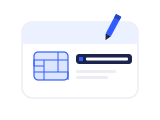
Name it “eSIM” so it’s obvious in your line picker.
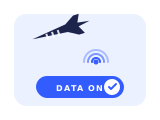
Toggle the eSIM line on as you land. Data works on the jet bridge.
Most iPhones from the XS generation onward, along with recent flagship Android phones from Samsung, Google, and other major manufacturers, support eSIM. Check your device settings for “Add eSIM” or “Add Cellular Plan” before departure.
XS, XR, 11, 12, 13, 14, 15, 16 & SE (2nd gen+)
Most modern phones support dual SIM, running an eSIM for data alongside a physical home SIM in the same device, or two eSIM profiles side by side on newer models. The home SIM keeps its original number active for calls and text messages while the Namibia eSIM handles data over MTC or TN Mobile, with both able to run simultaneously without swapping cards at any point in the trip.
In Namibia specifically, this matters most for arrival logistics and rural stretches. A traveler can keep their home number reachable for banking verification codes or family calls while the Namibia eSIM handles navigation on the B1 highway toward Etosha, WhatsApp check-ins with safari lodges, and booking confirmations for camps at Sesriem or Swakopmund.
A common mistake is assuming data roaming will simply work as a backup once the eSIM signal drops in a remote stretch like the Skeleton Coast or deep Damaraland, without checking that home-network roaming is even enabled or affordable in Namibia beforehand. Confirming international roaming settings on the home SIM before departure avoids a surprise bill if it briefly picks up signal outside the eSIM’s coverage.
Most travelers on a short trip are comfortable with 2 to 5 GB, depending on how much navigation, streaming, and social sharing they plan to do. Use the calculator below to match a plan to your actual usage.
Activity | Avg rate | Intensity | 7–14 day total |
|---|---|---|---|
Google Maps + navigation | 50 MB/hr | ~3 GB 5 hr/day × 7 days | |
Instagram, TikTok, social | 700 MB/hr | ~10 GB 1 hr/day × 14 days | |
YouTube / Netflix (480p) | 550 MB/hr | ~8 GB 1 hr/day × 14 days | |
Work calls + email | 200 MB/hr | ~4 GB 2 hr/day × 10 days | |
iMessage, WhatsApp, light | 10 MB/hr | <1 GB Background use |
Rule of thumb: 3 GB for a 1-week sightseeing trip, 10 GB for two weeks with social media + streaming, unlimited for any trip with daily Zoom calls or remote work.